ONDERNEEM NU ACTIE
WACHT NIET LANGER
Why this model exists
Organizations rarely fail due to lack of talent, strategy, or technology. They fail because the way work is structured does not match how value is created. Value flows horizontally from idea to outcome, while organizations are designed vertically around functions, silos, and control. The result is systemic delay, not individual inefficiency. This model addresses that mismatch.
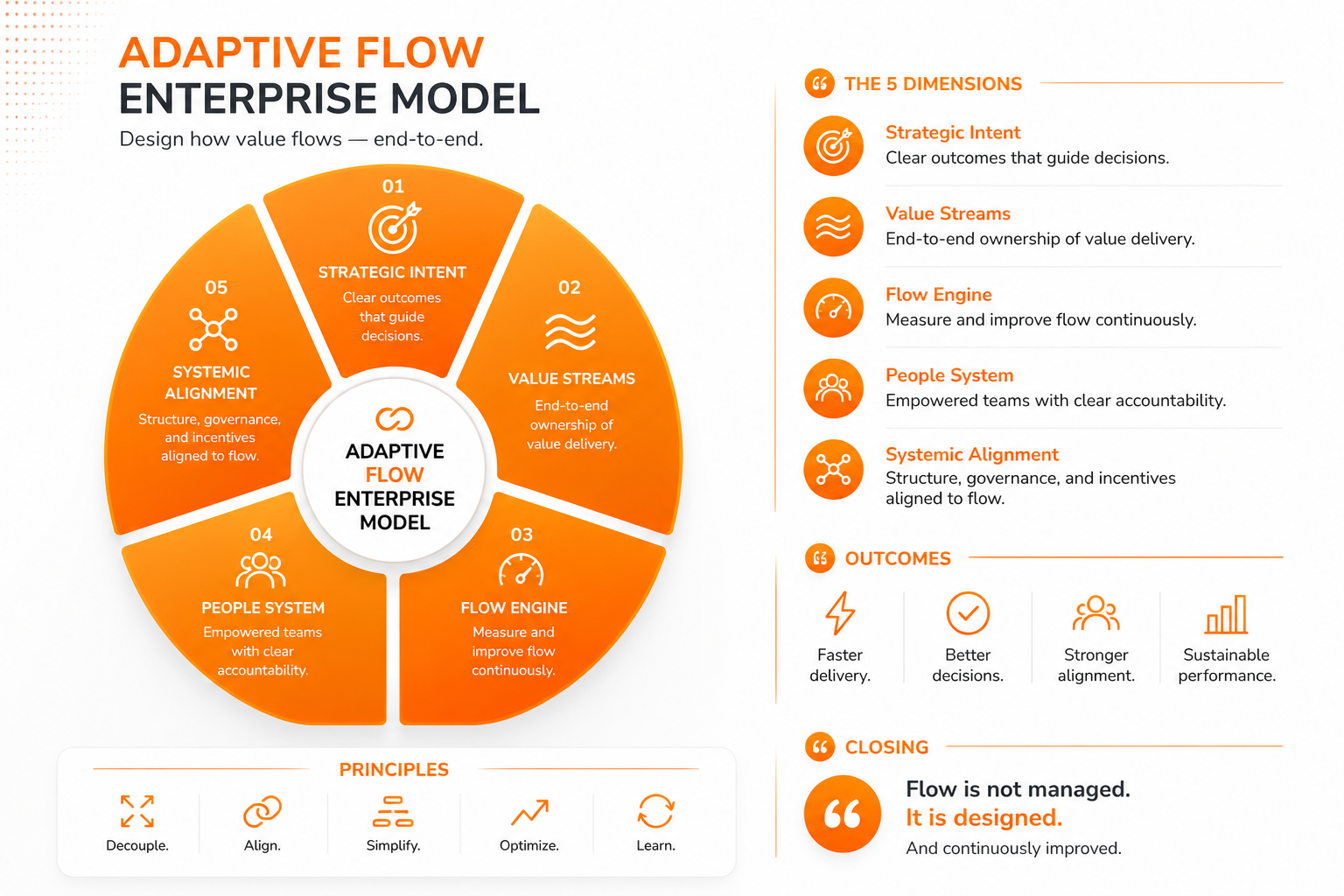
Why the five dimensions are necessary
Each dimension resolves a specific structural constraint. Remove one, and the system degrades. Strategy has no impact unless it shapes day-to-day decisions. When direction is not translated into execution, alignment breaks down. When work is not organized around outcomes, handoffs, delays, and fragmentation increase. Continuity in value delivery is lost. What cannot be seen or measured cannot be improved. Without visibility, performance remains unpredictable. Even well-designed systems fail when people lack clarity, safety, or decision authority. Human conditions determine how the system performs. When governance, funding, and incentives are misaligned, the system works against itself. Local optimization undermines overall performance.
Why these principles matter
These are not best practices. They are design constraints for complex systems. Without them, decisions slow down, coordination increases, adaptability decreases, and improvement becomes reactive. They ensure a balance between scale and adaptability and define how the system behaves under pressure.
Why the outcomes matter
The outcomes are not targets. They are signals of a well-designed system. In traditional organizations, performance depends on individual effort. In this model, performance emerges from system design. When these outcomes appear, it indicates that friction has been structurally reduced, decisions happen closer to value creation, and the system can adapt without central control.
Core idea
Organizations do not improve by working harder. They improve by being better designed.
Positioning
This model makes explicit what is usually invisible: performance is not a property of teams, but of the system in which they operate.