The hidden structural paradox of growth
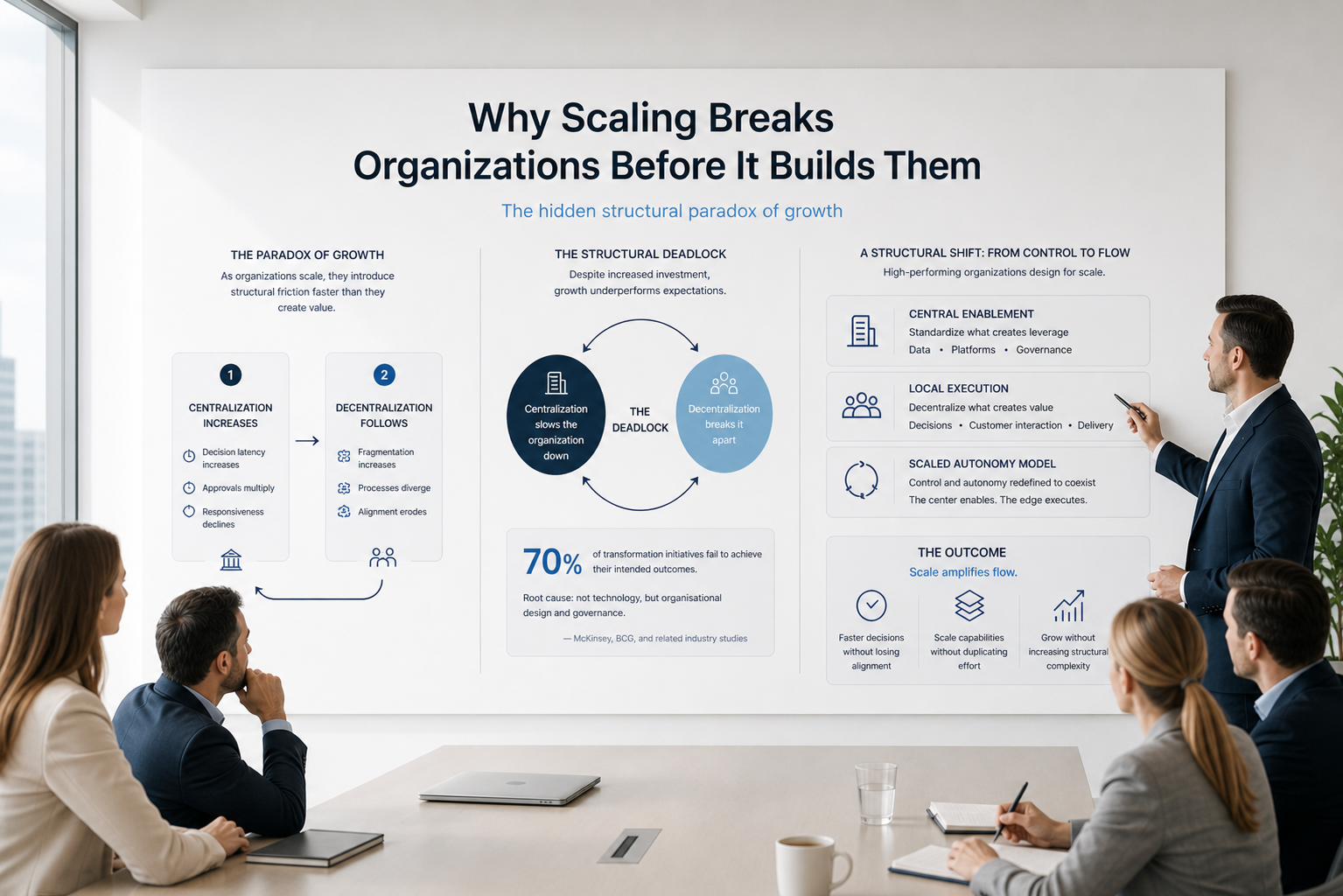
Most leadership teams still assume that scale inherently drives efficiency. The logic is intuitive: more volume should lead to lower costs, stronger leverage, and faster growth. In practice, the opposite often occurs. As organizations scale, they introduce structural friction faster than they create value.Two predictable dynamics emerge.First, centralization increases. Standards, governance, and control mechanisms are tightened to maintain consistency. However, this comes at a cost: decision latency increases, approvals multiply, and responsiveness declines.Second, decentralization follows as a counter-reaction. Business units and local teams regain autonomy to move faster. Yet this creates a new problem: fragmentation. Processes diverge, systems duplicate, and alignment erodes.The result is a structural deadlock:
- Centralization slows the organization down
- Decentralization breaks it apart
Despite increased investment, growth underperforms expectations.Empirical evidence supports this pattern. Research consistently shows that up to 70% of transformation initiatives fail to achieve their intended outcomes, with the root cause not in technology, but in organizational design and governance (McKinsey, BCG, and related industry studies).This points to a deeper issue. The problem is not scale itself.
The problem is that most organizations are not designed to absorb scale.
What leaders consistently underestimate
Scaling does not fail because organizations become more complex.
It fails because the operating model was never engineered for that complexity.Most organizations evolve incrementally. Structures, processes, and decision rights are layered over time. What emerges is not a system designed for scale, but a patchwork optimized for a smaller, earlier version of the organization. At scale, that patchwork collapses under its own weight.
A structural shift: from control to flow
Organizations that scale successfully take a fundamentally different approach. They stop treating scale as a coordination problem and start treating it as a system design problem.A key pattern emerges across high-performing organizations:
- They separate central enablement from local execution
- They standardize what creates leverage (data, platforms, governance)
- They decentralize what creates value (decisions, customer interaction, delivery)
This is the core logic behind the Scaled Autonomy Model.Instead of choosing between control and autonomy, the model redefines how both coexist. The center no longer acts as a bottleneck, but as a platform. Local entities no longer operate in isolation, but within clear, enabling boundaries.
The outcome
When designed correctly, scale no longer introduces friction.
It amplifies flow. Organizations become capable of:
- making faster decisions without losing alignment
- scaling capabilities without duplicating effort
- growing without increasing structural complexity
Bottom line
Scale does not break organizations.
Poorly designed operating models do.The organizations that win are not those that grow the fastest, but those that redesign themselves to sustain that growth.