Why integration destroys more value than it creates
Buy-and-build strategies are designed to accelerate growth through acquisition, leveraging scale, synergies, and market consolidation. In theory, they offer a compelling path to rapid expansion. In practice, value erosion during post-merger integration remains a persistent and underestimated risk.
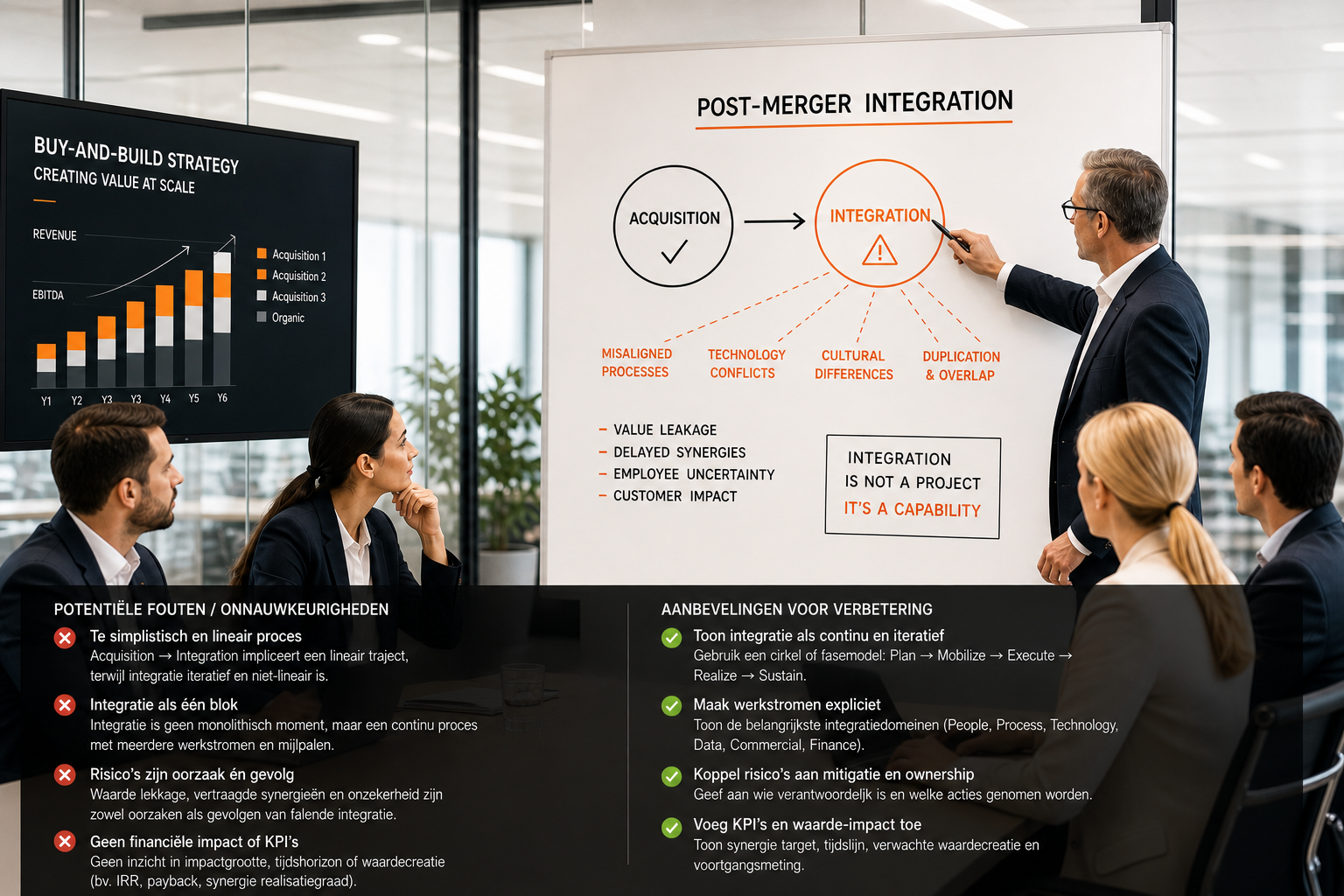
The complexity of integration extends far beyond systems consolidation. Organizations must reconcile misaligned processes, incompatible technologies, and fundamentally different operating cultures. These challenges are compounded by duplicated structures and unclear accountability, which introduce inefficiencies rather than synergies.
However, the most critical—and often overlooked—dimension is capability integration. Transferring knowledge, aligning ways of working, and embedding shared capabilities across entities is significantly more difficult than integrating systems or reporting lines. It is here that most value leakage occurs.
A common misconception among leadership teams is to treat integration as a finite project. This perspective is flawed. Integration is not an event with a defined endpoint; it is a continuous organizational capability that must be institutionalized.
Leading acquirers differentiate themselves through a distinct structural approach. They centralize elements that benefit from standardization—such as data architecture, governance frameworks, and core platforms—while preserving autonomy in customer-facing execution. This balance enables both efficiency and entrepreneurial responsiveness.
The result is materially different. Integration cycles shorten, local innovation is preserved, and synergies scale more effectively across the portfolio.
The implication is clear: sustainable value creation in buy-and-build strategies depends less on acquisition strategy and more on the ability to operationalize integration as a repeatable, scalable capability.