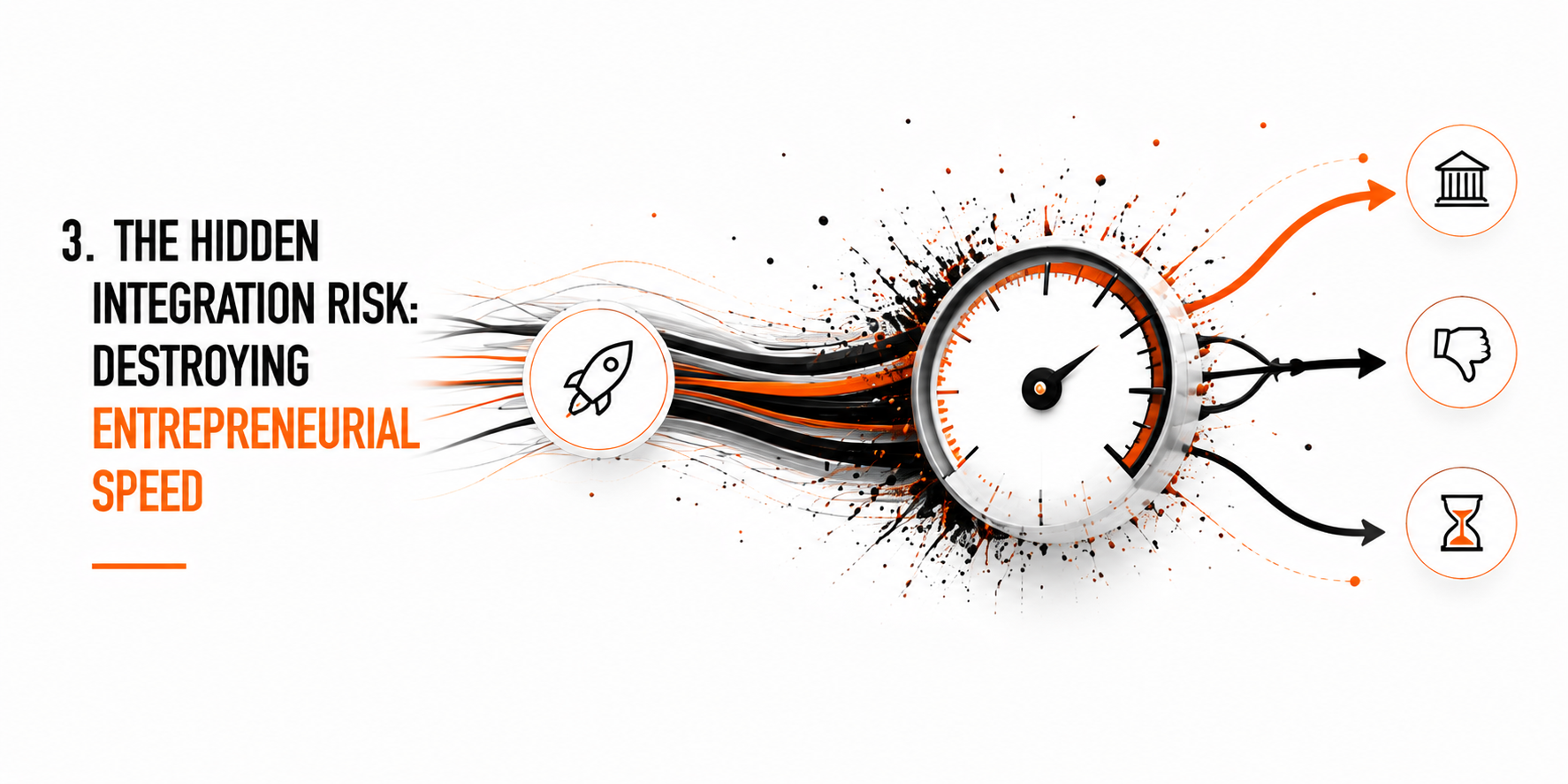
Why Large Organizations Accidentally Slow Acquired Companies Down
Many acquisitions are driven by a desire to acquire:
- innovation
- agility
- market expertise
- entrepreneurial capability
- customer intimacy
Yet after integration, these capabilities often deteriorate rapidly.
Why?
Because large organizations unintentionally introduce structural friction into the acquired business.
How Bureaucracy Expands During Integration
After acquisition, organizations frequently add:
- governance layers
- approval structures
- reporting requirements
- centralized controls
- coordination forums
Decision-making gradually moves upward through the hierarchy.As a result:
- responsiveness declines
- execution slows
- adaptability weakens
- entrepreneurial behavior decreases
The organization becomes operationally larger but strategically slower.
The Structural Paradox of Scaling
This creates a dangerous paradox:Organizations scale operationally while losing the agility that created value originally.High-performing buy-and-build organizations avoid this trap by separating:
- central enablement
from - local execution
Headquarters provides:
- governance frameworks
- enterprise platforms
- strategic direction
- shared capabilities
But local entities retain:
- customer responsiveness
- execution ownership
- market adaptation
- operational flexibility
Why Scaled Autonomy Matters
This creates scalable autonomy.The objective is not controlling every decision centrally.It is creating enough alignment to scale while preserving enough flexibility to remain adaptive.Organizations that fail to balance this eventually create:
- integration fatigue
- slower decision-making
- reduced innovation
- organizational rigidity
Organizations that succeed preserve entrepreneurial energy while improving enterprise leverage simultaneously.
Bottom Line
Acquisitions rarely fail because organizations grow too quickly.
They fail because integration introduces more friction than flow.
The strongest buy-and-build organizations scale governance and capabilities without destroying entrepreneurial speed.
By Erlend Hollebosch
Organizational Development Lead | Grow Faster