ONDERNEEM NU ACTIE
WACHT NIET LANGER
How to use the adaptive Flow Enterprise Model?
From Leadership Perspective
Driving performance through a continuous flow loop
Most organizations do not suffer from a lack of strategy or talent. They suffer from invisible friction in how value moves. High-performing organizations address this by applying a simple but disciplined leadership mechanism: Understand → Simplify → Accelerate → Learn
This loop enables leaders to continuously improve performance by making the system visible, reducing structural complexity, and scaling what works.
The 4-step leadership loop
1. Understand — make flow visible
Leaders establish transparency on how value actually moves across the organization. This typically includes:
- end-to-end lead time
- waiting vs. execution time
- dependency mapping across teams
Insight: In most organizations, 60–80% of lead time is idle time.
The objective: is not reporting. It is exposing where value slows down.
2. Simplify — remove structural friction
Once constraints are visible, leaders act on the system — not on individual teams. Typical interventions include:
- reducing handovers
- embedding decision-makers into the flow
- eliminating unnecessary governance layers
Insight: Complexity is rarely operational. It is designed into the structure.
The goal is not optimization. It is friction removal.
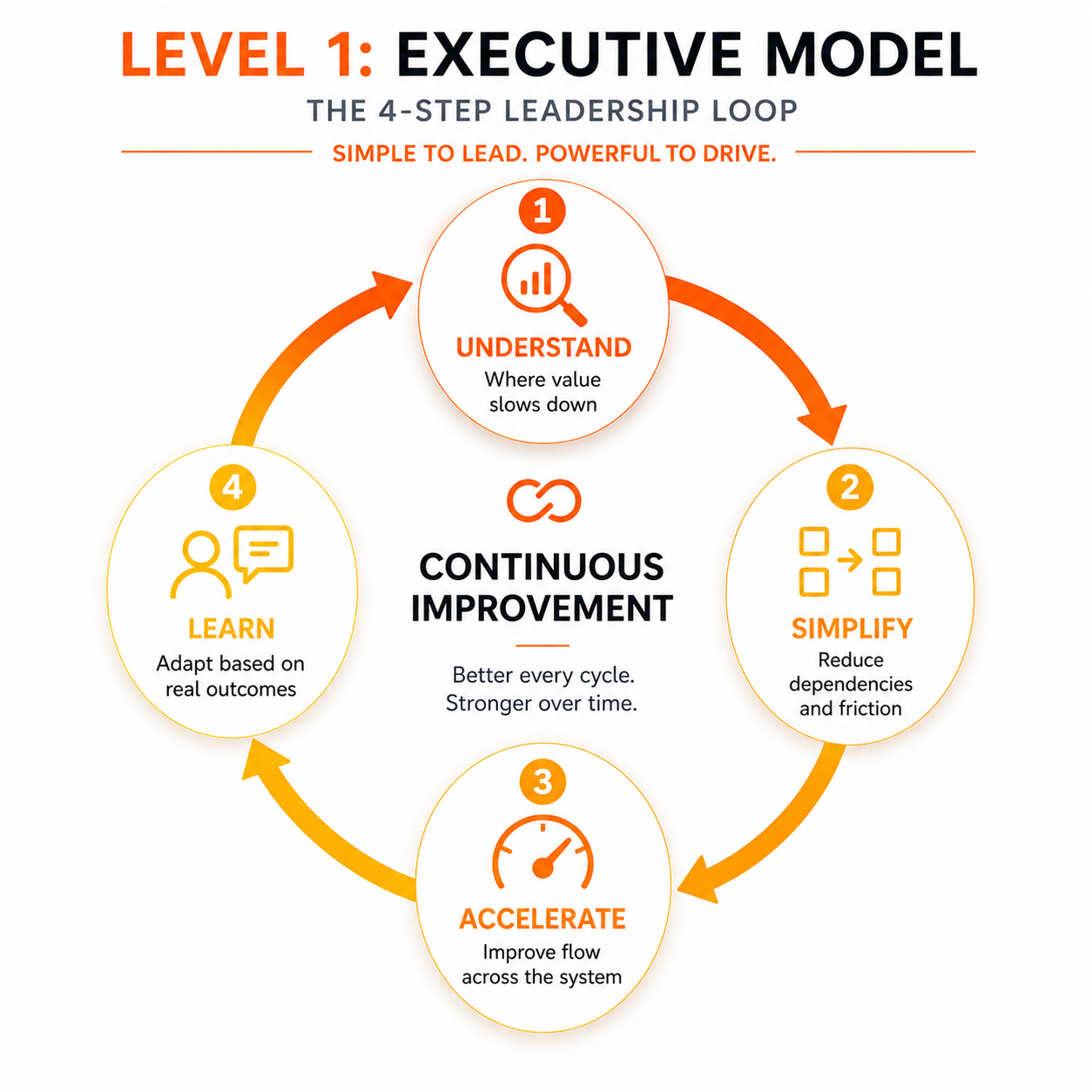
3. Accelerate — improve end-to-end flow
With reduced friction, the system begins to move faster. Leaders reinforce this by:
- aligning teams around value streams
- enabling faster local decision-making
- prioritizing flow over utilization
Insight: Speed does not come from doing more. It comes from doing fewer things with less interruption.
The focus shifts from activity to throughput and predictability.
4. Learn — adapt based on outcomes
Performance is continuously measured and translated into learning.This includes:
- tracking lead time, throughput, and quality
- identifying what improved flow — and what did not
- feeding insights into the next iteration
Insight: Sustainable performance comes from system learning, not one-time change.
The loop restarts — stronger each cycle.