ONDERNEEM NU ACTIE
WACHT NIET LANGER
Case Example: Restoring Flow in a Complex Organization
Context
A major organisation was struggling to deliver customer value at speed. Despite strong teams and significant investment, delivery remained slow and unpredictable. New customer onboarding — a critical growth driver — took 9 to 12 months to reach production.
The Challenge
The issue was not effort, talent, or funding. It was structural.
- Work was fragmented across functions
- Dependencies slowed down execution
- Decisions required multiple approvals
- Ownership was unclear across the end-to-end flow
Value was being created — but not realized.
Our Approach
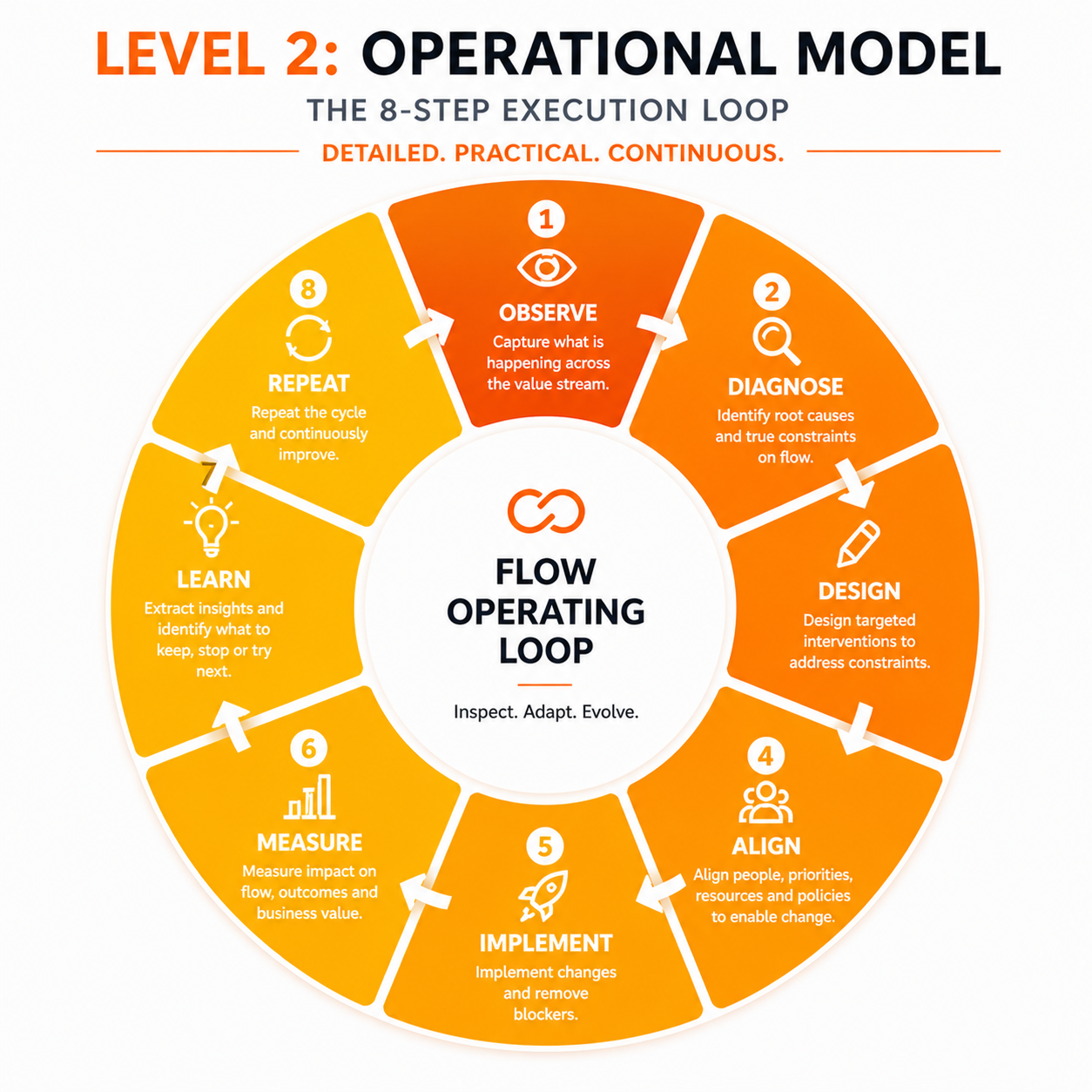
Instead of optimizing teams, we redesigned how value flows. We applied the Flow Operating Loop to one critical value stream: digital onboarding.
1. Make Flow Visible
- We mapped the full journey from idea to delivery.
- This revealed that over 70% of lead time was waiting, not execution.
- Work stalled between teams, approvals, and handovers.
2. Identify Structural Constraints
We diagnosed the root causes behind the delays:
- Functional silos instead of end-to-end ownership
- Governance designed for control, not speed
- Misaligned incentives across teams
The problem was not performance — it was system design.
3. Redesign the System
We introduced targeted changes:
- Defined a single end-to-end value stream
- Created a cross-functional team with full ownership
- Embedded Risk and Compliance into the flow
- Reduced approval layers from six to two
4. Align the Organization
We adjusted the conditions around the system:
- Governance simplified to enable faster decisions
- Funding aligned to value streams instead of functions
- Decision-making pushed closer to the work
5. Implement and iterate
- The new model was implemented incrementally.
- Teams began working in a continuous flow, supported by daily synchronization and visible work management.
- Bottlenecks were actively identified and resolved.
6. Measure and Learn
Performance was tracked continuously:
- Lead time reduced from 120 days to 75 days within months
- Throughput increased
- Rework decreased
- Decision speed improved significantly
Each iteration generated new insights, feeding the next cycle of improvement.
The Result
The organization did not work harder.
It worked differently.
- Faster delivery across the value stream
- Clear ownership from idea to outcome
- Fewer dependencies and delays
- More predictable and reliable outcomes
Most importantly, the system became capable of continuous improvement.
Key Insight
The breakthrough did not come from scaling teams or adding resources.It came from redesigning how value flows across the system.
Closing
This case demonstrates a fundamental shift:
Performance is not driven by effort.
It is determined by system design.