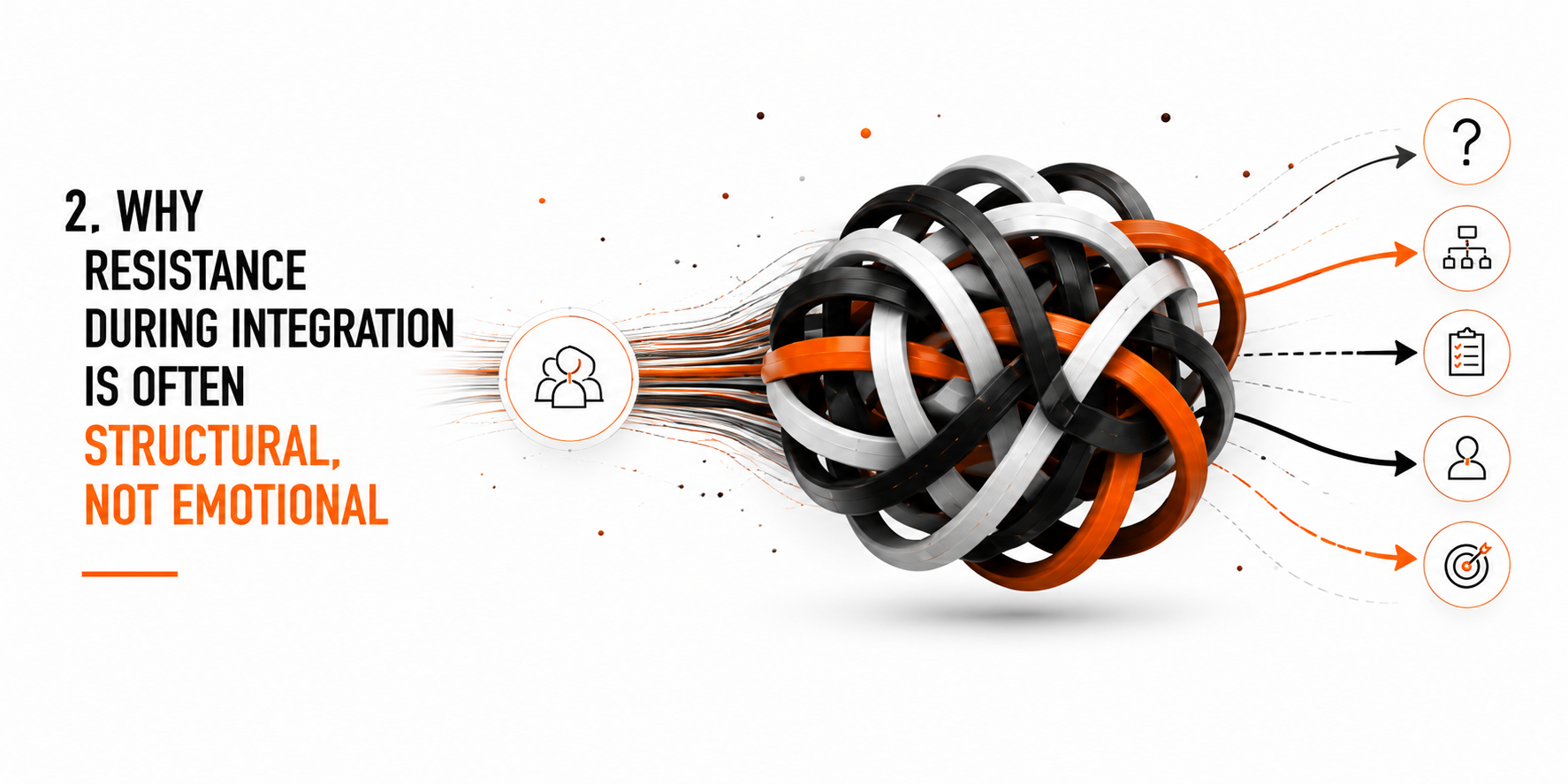
Organizations Resist When Operating Models Collide
Post-merger resistance is frequently described as a cultural problem.
In reality, resistance is often structural.
When organizations integrate, employees suddenly face:
- unclear accountability
- changing decision rights
- conflicting priorities
- duplicated governance
- disrupted workflows
This creates operational instability across the enterprise.
Most resistance is not irrational opposition to change.
It is a reaction to uncertainty inside the operating model itself.
Why Structural Ambiguity Creates Friction
During integration, teams begin asking:
- Who owns decisions now?
- Which processes apply?
- Which priorities matter most?
- How will performance be measured?
- What remains local versus centralized?
When these questions remain unresolved, organizations experience:
- escalation overload
- duplicated work
- political tension
- coordination friction
- slower execution
The organization becomes structurally harder to operate.
Why High-Performing Integrations Reduce Uncertainty
High-performing acquirers manage integration differently.
Instead of imposing immediate centralized control, they create:
- decision clarity
- governance simplicity
- transparent integration principles
- clear ownership boundaries
Most importantly, they communicate what will remain stable.
This significantly reduces defensive organizational behavior.
People resist less when they understand:
- what changes
- what stays consistent
- why decisions are made
Why Integration Is Primarily an Operating Model Challenge
Successful integration depends less on pressure and more on organizational clarity.
Organizations slow down when:
- governance becomes fragmented
- accountability becomes unclear
- coordination complexity increases
The issue is rarely culture alone.
It is usually structural ambiguity.
Bottom Line
Most post-merger resistance is not emotional resistance to change.
It is a response to instability inside the operating model.
Organizations that reduce ambiguity, simplify governance and clarify ownership consistently experience smoother integrations and faster alignment.
By Erlend Hollebosch
Organizational Development Lead | Grow Faster