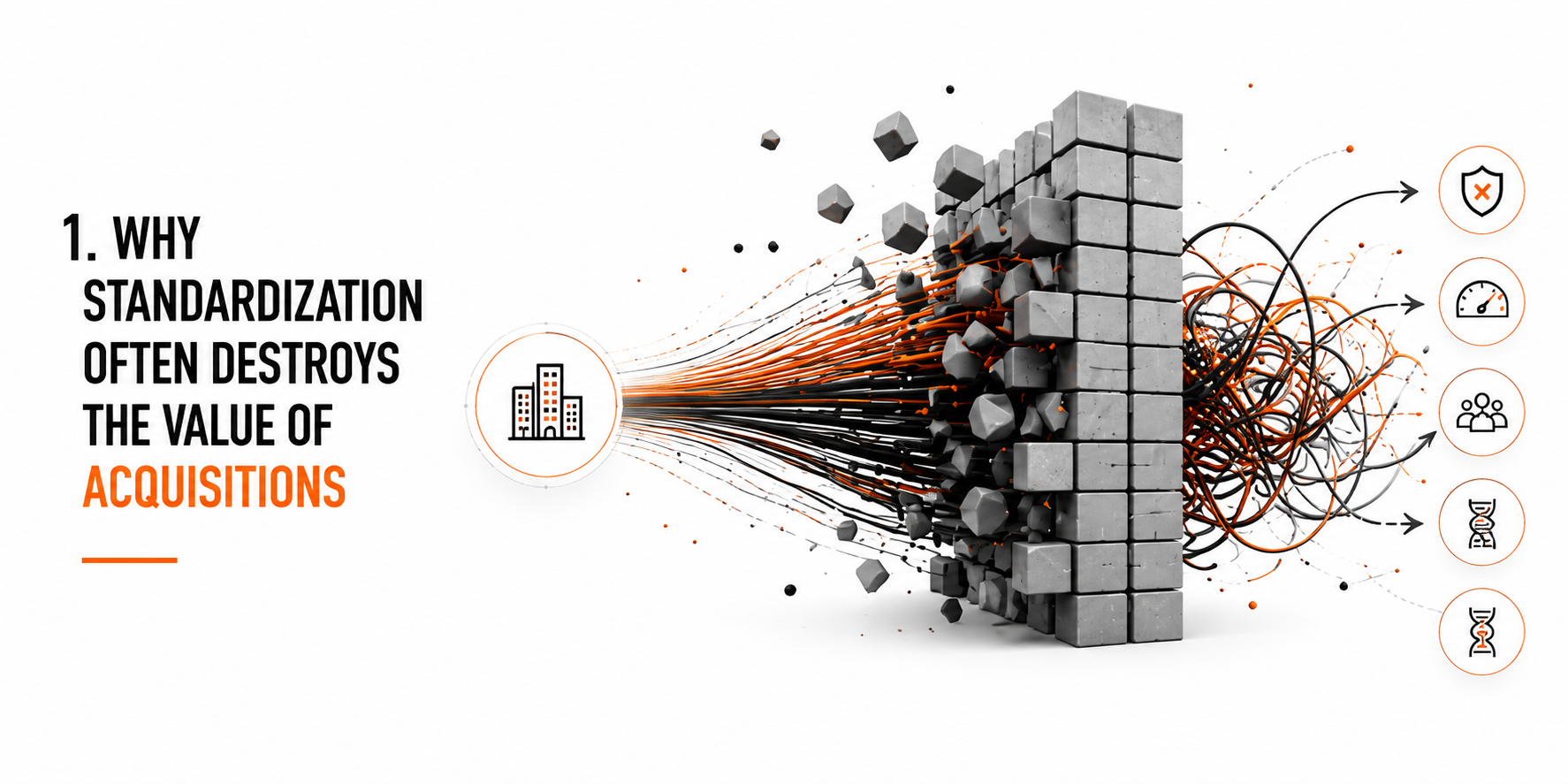
Why Integration Becomes Destructive When Organizations Lose Their Identity
Buy-and-build strategies are designed to create:
- scale
- operational leverage
- market expansion
- synergy realization
- enterprise efficiency
After acquisitions, headquarters often moves quickly to standardize:
- governance
- reporting structures
- operating processes
- systems and platforms
- decision-making frameworks
The rationale appears logical.
Standardization promises:
- consistency
- scalability
- control
- operational efficiency
- integration speed
Yet many organizations begin destroying value precisely during this phase.
Why Acquired Organizations Begin Resisting
Organizations are not simply operational structures.
They are behavioral systems shaped by:
- leadership dynamics
- customer relationships
- local market expertise
- entrepreneurial decision-making
- cultural identity
When integration removes these characteristics too aggressively, organizations lose the very capabilities that originally made them attractive acquisition targets.
This creates predictable resistance.
Local entities begin protecting:
- autonomy
- speed
- customer proximity
- operational flexibility
- local ways of working
Headquarters often interprets this as misalignment.
In reality, it is frequently a response to organizational dilution.
The Difference Between Leverage and Value Creation
High-performing acquirers understand an important principle: Not everything should be standardized.
They distinguish between:
- what creates enterprise leverage
and - what creates local value
They centralize:
- governance principles
- enterprise platforms
- shared data structures
- scalable capabilities
But they preserve flexibility in:
- customer interaction
- local execution
- market responsiveness
- operational adaptation
The objective is not organizational uniformity.
It is scalable coherence.
Why the Best Integrations Preserve Identity
The strongest integrations are not the most centralized.
They are the ones balancing:
- enterprise consistency
- local entrepreneurship
- operational alignment
- organizational adaptability
These organizations scale without eliminating the DNA of acquired companies.
Because long-term value creation depends not only on integration efficiency, but on preserving the capabilities that drive growth in the first place.
Bottom Line
Standardization creates value only when applied selectively.
Organizations that over-centralize integrations often eliminate the very strengths they intended to scale.
The most successful buy-and-build organizations understand that sustainable integration requires balancing enterprise alignment with local identity.
By Erlend Hollebosch
Organizational Development Lead | Grow Faster