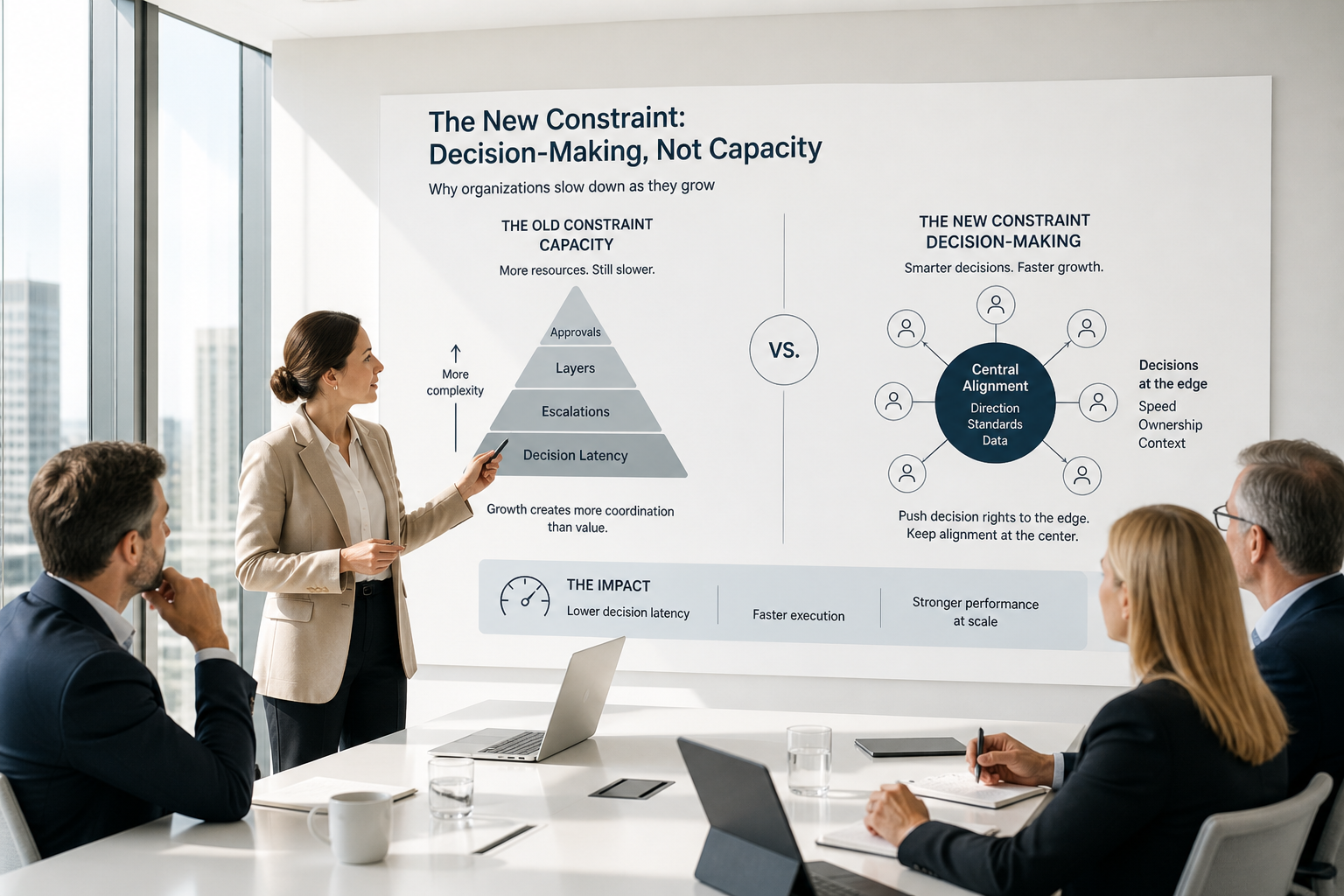
Why organizations slow down as they grow
Conventional wisdom suggests that organizational growth is constrained by resources—talent, systems, or capital. While these factors remain relevant, they are no longer the primary bottleneck in large-scale organizations.
The dominant constraint today is decision latency.
As organizations expand, decision-making authority tends to migrate upward. Layers of approval are introduced to manage perceived risk, and ownership becomes increasingly diffused across functions and hierarchies. The result is a systemic slowdown.
This dynamic creates a structural inefficiency: growth generates more coordination effort than value creation. Teams spend increasing amounts of time aligning, escalating, and waiting for decisions, rather than executing.
Recent research in both AI-enabled organizations and broader operating model design reinforces this conclusion. High-performing organizations are not distinguished by superior capabilities alone, but by their ability to minimize decision friction through effective governance and alignment mechanisms.
The critical shift involves redefining where decisions are made. Decision rights must be pushed to the edge of the organization, closer to the customer and the point of value creation. At the same time, alignment must remain centralized through clear strategic direction, standardized frameworks, and shared data.
This combination reduces latency without introducing chaos. It preserves control at the system level while enabling speed at the execution level.
For leadership, the implication is precise: scaling performance requires redesigning decision architectures, not merely increasing capacity.