The next evolution in operating models
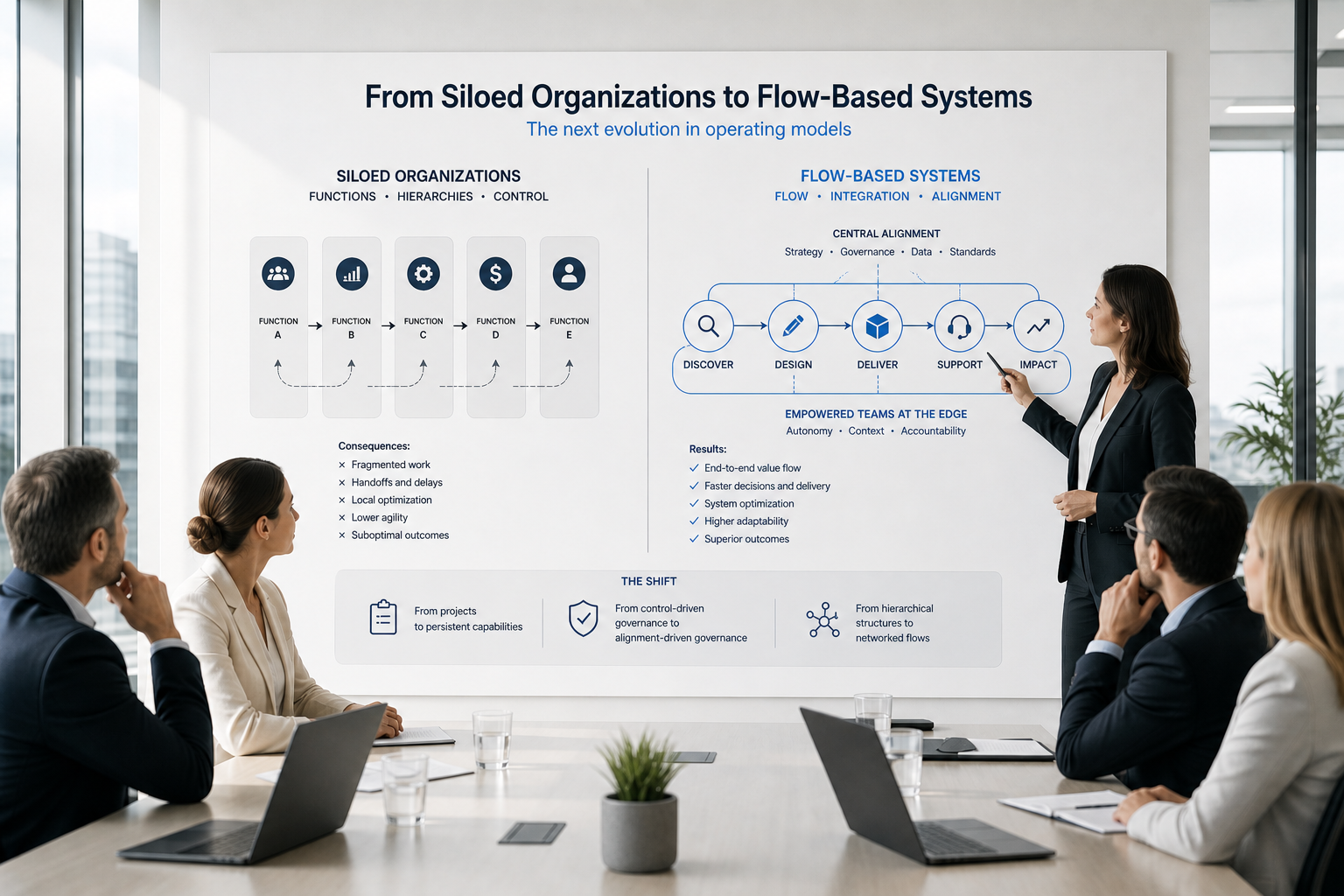
Traditional organizations are structured around functions, hierarchies, and control mechanisms. These structures were optimized for efficiency and predictability in relatively stable environments. However, they are increasingly misaligned with the demands of modern value creation.
Today’s environment requires speed, integration, and adaptability. Value is created not within isolated functions, but across end-to-end flows that cut through organizational boundaries.
Both scientific research and industry practice are converging on a consistent conclusion: organizations must transition from siloed structures to flow-based systems.
In a siloed model, work is fragmented. Handoffs between functions introduce delays, misalignment, and loss of accountability. Optimization occurs locally rather than systemically, leading to suboptimal overall performance.
In contrast, a flow-based system is designed around the continuous delivery of value. It prioritizes end-to-end integration, minimizes handoffs, and aligns teams around shared outcomes rather than functional outputs.
This shift is also evident in AI transformation efforts. Success depends on the ability to integrate data, learning, and decision-making across the entire system. Isolated capabilities, regardless of their sophistication, are insufficient.
The transition requires a fundamental rethinking of the operating model:
- from projects to persistent capabilities
- from control-driven governance to alignment-driven governance
- from hierarchical structures to networked flows
Operationalizing this model involves embedding integration as a core capability, rather than treating it as an exception. It also requires aligning local autonomy with system-wide coherence, ensuring that decentralized execution contributes to overall performance.
This is not an incremental improvement. It represents a structural evolution in how organizations are designed and operated.