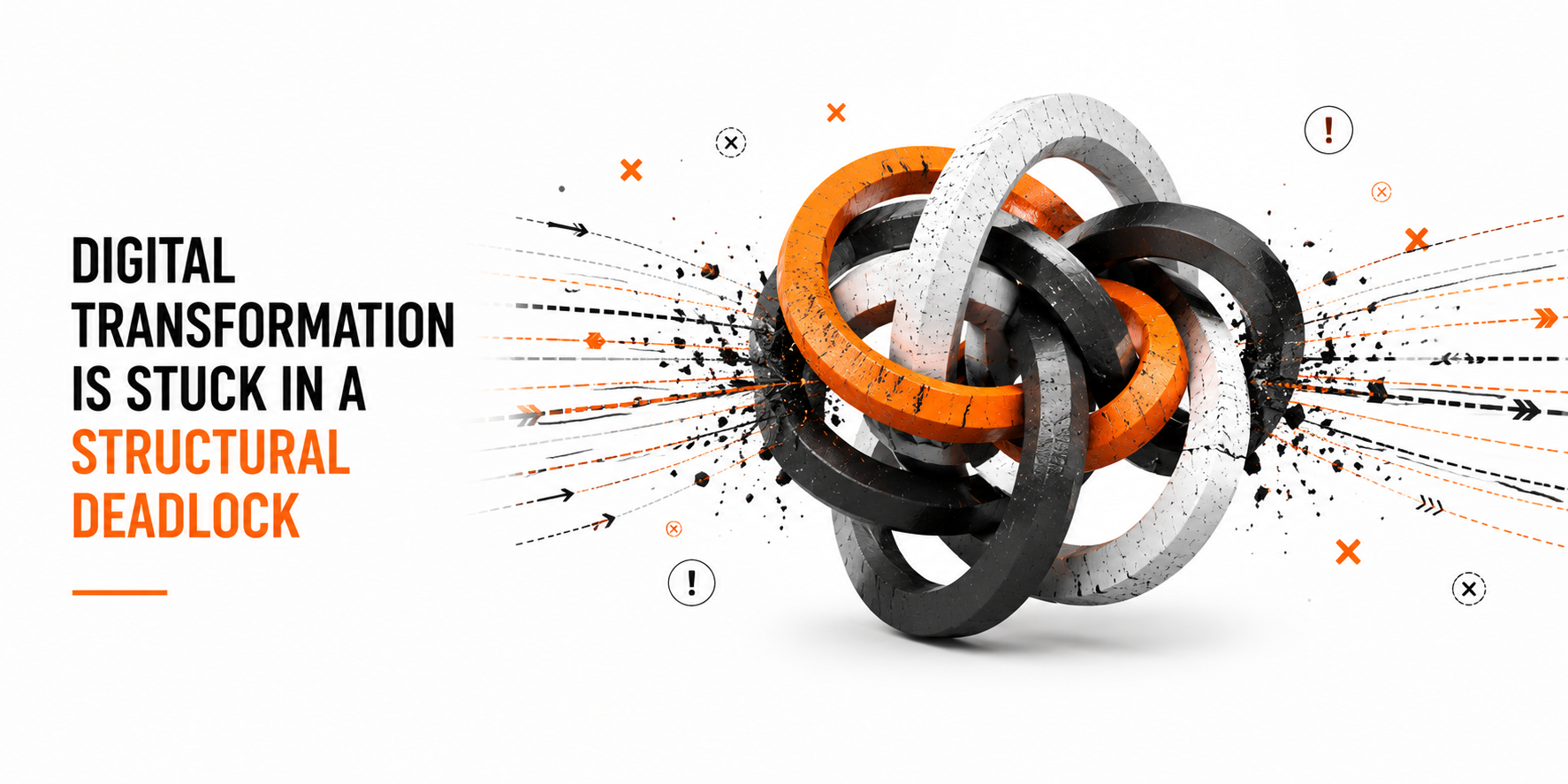
Why More Investment Delivers Less Impact
Global investment in digital transformation continues to grow at an unprecedented pace.
Organizations are investing heavily in:
- cloud platforms
- enterprise systems
- AI capabilities
- automation technologies
- digital customer experiences
- data infrastructures
Yet despite this enormous investment, business impact often remains inconsistent and disappointing.
Many organizations spend more on digital transformation while becoming:
- slower
- more complex
- harder to coordinate
- less responsive to change
The problem is increasingly clear.
Digital transformation is not primarily constrained by technology.
It is constrained by organizational design.
Why Technology Alone Does Not Transform Organizations
Most organizations approach digital transformation as a technology deployment initiative.
The assumption is straightforward:
new systems will create new capabilities.
However, technology does not operate independently from the organization itself.
Transformation outcomes are ultimately determined by:
- decision-making structures
- governance models
- accountability design
- coordination mechanisms
- operating model architecture
When these structures remain unchanged, new technologies are simply layered onto old organizational logic.
This creates structural friction instead of transformation.
The Structural Paradox of Digital Transformation
As organizations introduce more platforms, systems and tools, complexity often increases rather than decreases.
Decision-making slows down.
Coordination overhead expands.
Dependencies multiply across teams and functions.
The organization becomes structurally less adaptive despite becoming technologically more advanced.
This creates a paradoxical outcome:
The more organizations invest in digital transformation, the harder transformation becomes.
Why Traditional Governance Models Fail
The root issue lies in governance and organizational structure.
Traditional operating models are typically designed around:
- centralized decision-making
- hierarchical accountability
- functional optimization
- control-oriented governance
- siloed execution structures
These principles were designed for stability and efficiency.
Digital environments require something fundamentally different:
- speed
- adaptability
- decentralized execution
- rapid decision cycles
- cross-functional coordination
This creates a structural incompatibility between traditional organizations and digital operating requirements.
What High-Performing Organizations Do Differently
Organizations that successfully scale digital transformation redesign their operating model intentionally.
They centralize what creates leverage:
- enterprise platforms
- shared data capabilities
- governance principles
- architectural standards
- reusable services
At the same time, they decentralize what creates responsiveness:
- execution
- operational decisions
- customer interaction
- product delivery
- contextual adaptation
This balance enables organizations to maintain alignment without creating excessive coordination overhead.
From Control to Enablement
High-performing organizations also rethink governance itself.
Governance no longer exists primarily to enforce control.
It exists to enable alignment.
This distinction matters significantly.
Instead of slowing execution through approvals and escalations, governance becomes a mechanism for:
- transparency
- prioritization
- decision clarity
- shared standards
- system-level coherence
The organization shifts from hierarchical coordination toward scalable flow.
The Real Transformation Challenge
Digital transformation is rarely limited by the quality of technology.
It is limited by the organization’s ability to absorb change structurally.
Without operating model redesign:
- digital tools remain fragmented
- transformation programs lose momentum
- enterprise complexity increases
- investments generate diminishing returns
Technology alone cannot overcome structural misalignment.
Bottom Line
Digital transformation is not stuck because organizations lack technology.
It is stuck because traditional operating models were never designed for digital speed and adaptability.
The organizations that succeed are not necessarily those investing the most in technology.
They are the ones redesigning governance, decision-making and operating models to support scalable digital execution.
By Erlend Hollebosch
Organizational Development Lead | Grow Faster
digital transformation operating model enterprise transformation organizational design governance business transformation enterprise agility operating model design digital operating model strategic execution organizational scalability decision-making enterprise operating model transformation governance scalable organizations