Articles #enterprise operating model
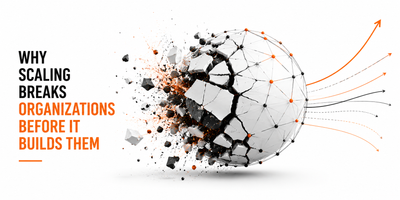
Most organizations assume scale naturally creates efficiency. In reality, growth often introduces structural friction faster than value. This article explores why traditional operating models fail at scale and how organizations can redesign for flow, adaptability and sustainable growth.
Read More
Many buy-and-build strategies fail to realize expected synergies because integration creates structural friction faster than value. This article explores why post-merger integration is fundamentally an operating model challenge rather than a purely technical or financial exercise.
Read More
Many organizations continue increasing digital transformation investments while seeing limited business impact. This article explores why the real constraint is not technology itself, but the operating model, governance and organizational structures surrounding it.
Read More
As organizations grow, decision-making latency becomes a greater constraint than capacity itself. This article explores how governance structures, approval layers and fragmented accountability create structural friction that slows enterprise performance at scale.
Read More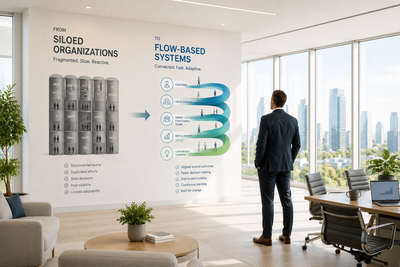
Traditional organizations were designed around functions and hierarchy. Modern enterprises require flow-based systems that prioritize integration, adaptability and end-to-end value delivery. This article explores why operating models are evolving from silos to scalable flow architectures.
Read More
Most organizations structure around departments instead of value flow. This article explores why identifying true value streams remains difficult and how operating models, governance and organizational design impact enterprise transformation success.
Read More
Most organizations overcomplicate value stream mapping by focusing on structures instead of flow. This article explores how leaders can identify their first value stream by exposing where coordination, dependencies and decision-making slow value delivery across the enterprise.
Read More
As organizations scale, value streams become increasingly interconnected through shared systems, governance and specialist teams. This article explores why dependency density creates structural complexity and how high-performing organizations redesign for scalable flow.
Read More
Dependencies are unavoidable in complex organizations, but unmanaged dependency friction can severely slow enterprise performance. This article explores how high-performing organizations reduce coordination complexity through scalable operating model design.
Read More
Traditional leadership models optimize functions and hierarchy. Modern organizations require leaders who optimize system-level flow across the enterprise. This article explores why leadership must evolve from managing silos to enabling scalable value flow.
Read More
Most organizations optimize departments, budgets and local KPIs while enterprise performance continues to slow down. This article explores why local optimization creates systemic friction and why high-performing organizations optimize for flow instead of isolated efficiency.
Read More
Fragmented accountability is one of the largest causes of execution friction inside organizations. This article explores why clear value stream ownership improves decision-making, reduces coordination overload and accelerates enterprise flow.
Read More