What is the Coherent Enterprise™ ?
What Is The Coherent Enterprise™?
A New Management Paradigm for the Complexity Era
Modern enterprises have never possessed more capability. They invest heavily in digital transformation, enterprise technology, organisational design, governance, project portfolios and strategic initiatives. New capabilities are continuously introduced to improve performance, strengthen competitiveness and enable growth. Yet many leadership teams experience an unexpected reality. Despite becoming more capable, their organisations often become more difficult to align, slower to coordinate and harder to execute. Decision-making slows. Transformation initiatives compete for limited organisational capacity. Cross-functional dependencies multiply. Governance expands. Organisational friction increases. The challenge is no longer simply managing complexity. It is maintaining coherence as complexity continues to grow. The Coherent Enterprise™ introduces a different way of thinking about enterprise performance. Rather than asking how individual functions can become more efficient, it asks a more fundamental question: how can an enterprise remain coherent as it becomes increasingly complex?
From Control to Coherence
For decades, organisations have responded to increasing complexity in predictable ways. As new challenges emerge, additional governance structures are introduced. Reporting requirements expand. New management layers are created. Coordination mechanisms multiply. Transformation programmes are launched to improve alignment and restore control. Each intervention appears reasonable in isolation. Collectively, however, they often create the opposite effect. Additional coordination creates additional coordination. More governance creates more interfaces. More control generates more organisational friction. The enterprise gradually becomes harder to move as an integrated system. The Coherent Enterprise™ proposes a different response. Instead of continuously adding mechanisms to control complexity, organisations should strengthen their ability to remain coherent despite complexity.
What Is Enterprise Coherence?
Enterprise coherence is the ability of an organisation to operate as one integrated system despite increasing complexity.
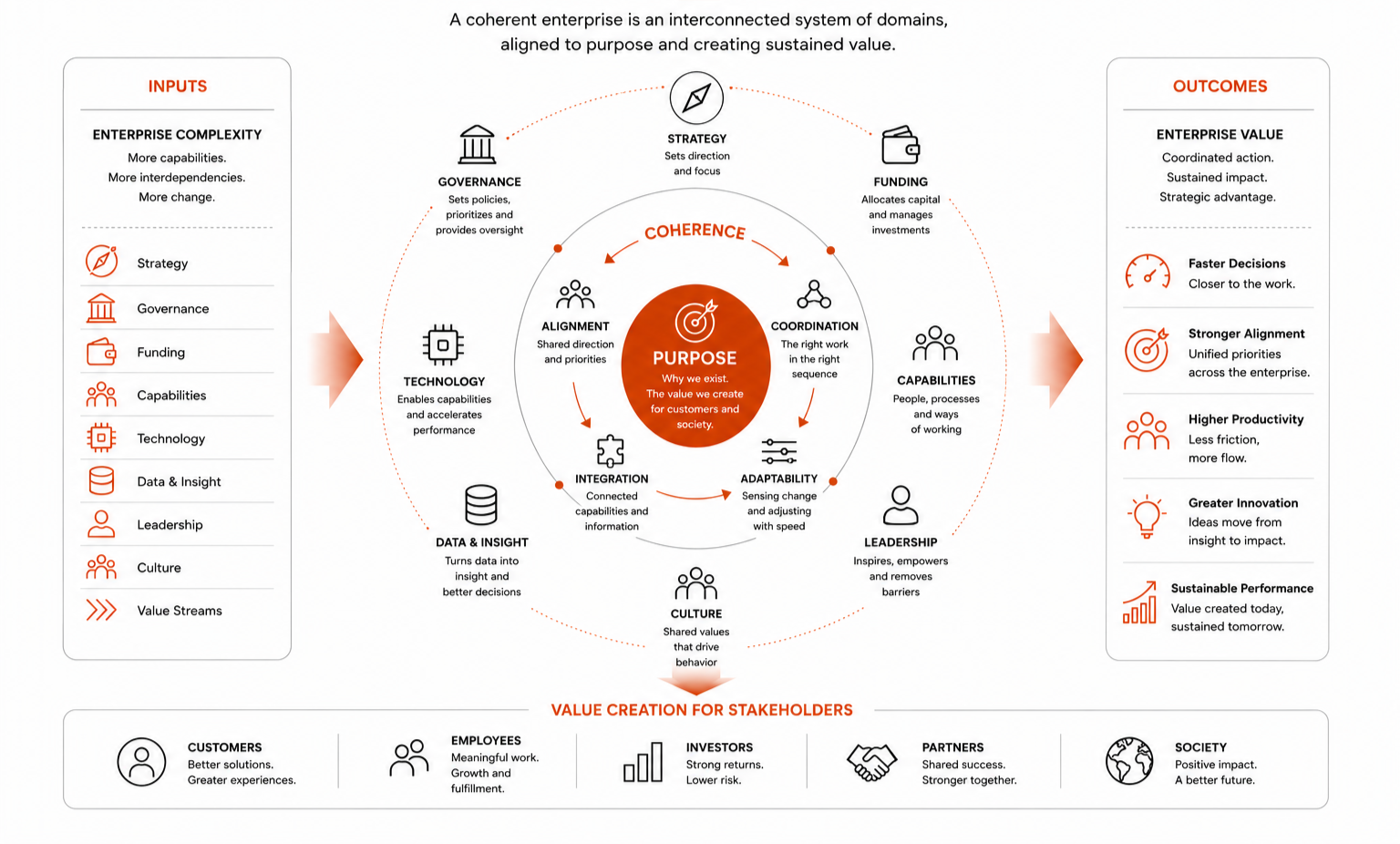
A coherent enterprise continuously aligns strategy, governance, funding, capabilities, technology, people, data and execution around a shared purpose. Coherence is therefore not:
- an organisational structure
- a governance framework
- a transformation programme
- a project methodology
- a technology platform
Instead, coherence represents an organisational capability. It enables the enterprise to:
- remain aligned as priorities evolve
- coordinate effectively across organisational boundaries
- make decisions quickly and consistently
- execute strategy predictably
- adapt without losing enterprise-wide alignment
As complexity grows, coherence determines whether the organisation continues to move as one system or gradually fragments into disconnected parts.
The Coherence Model™
Designing Organisations That Move as One
The Coherence Model™ provides the conceptual foundation of The Coherent Enterprise™. Rather than optimising individual organisational domains, the model examines how those domains interact as an integrated enterprise system. Enterprise performance emerges from the continuous interaction between:
- Strategy
- Governance
- Funding
- Enterprise Capabilities
- Technology
- Data
- Leadership
- Culture
- Value Streams
Most organisations invest considerable effort improving each of these domains individually. High-performing enterprises strengthen the connections between them. Because sustainable performance rarely depends on how strong individual capabilities are. It depends on how effectively those capabilities reinforce one another. The model enables leaders to:
- identify organisational fragmentation
- reduce structural friction
- clarify enterprise decision rights
- strengthen cross-functional alignment
- improve organisational flow
- prevent bureaucracy from growing alongside complexity
The objective is straightforward: ensure the enterprise functions as an integrated system rather than a collection of optimised parts.
Why Enterprise Coherence Matters
The future will not become simpler. Every organisation will continue to experience:
- more technology
- greater interdependence
- increasing regulation
- larger transformation portfolios
- growing organisational complexity
- faster market change
Every enterprise will therefore continue adding capabilities. Only some organisations will remain coherent while doing so.Those organisations will consistently outperform because they can:
- make faster decisions
- execute with less organisational friction
- scale without proportional bureaucracy
- adapt without losing alignment
- generate greater value from strategic investments
- sustain enterprise-wide performance over time
In an interconnected economy, competitive advantage increasingly depends not on what an organisation can do, but on how effectively it can move as one.
The Leadership Imperative
Every executive team eventually confronts the same strategic question. Can our capacity for coherence grow as rapidly as the complexity we continue to create? The answer determines whether the enterprise accelerates, stagnates or becomes constrained by the weight of its own success. The organisations that succeed in the coming decade will not necessarily possess the most technology, the largest budgets or the greatest number of capabilities. They will be the organisations that design for coherence. Because in increasingly complex enterprises, sustainable performance emerges not from stronger individual parts, but from stronger connections between those parts.