The Coherence Model™
Modern enterprises have never possessed greater resources with which to create value. They have access to unprecedented levels of talent, advanced technologies, vast quantities of data, specialised expertise, sophisticated governance mechanisms and an expanding portfolio of management practices designed to improve performance, accelerate innovation and strengthen organisational effectiveness.
Yet despite these advantages, many organisations are discovering that growth in capability does not automatically translate into growth in performance.
As enterprises become larger, more connected and more dependent on collaboration across functions, business units and technologies, they often find themselves becoming increasingly difficult to align, coordinate and adapt.
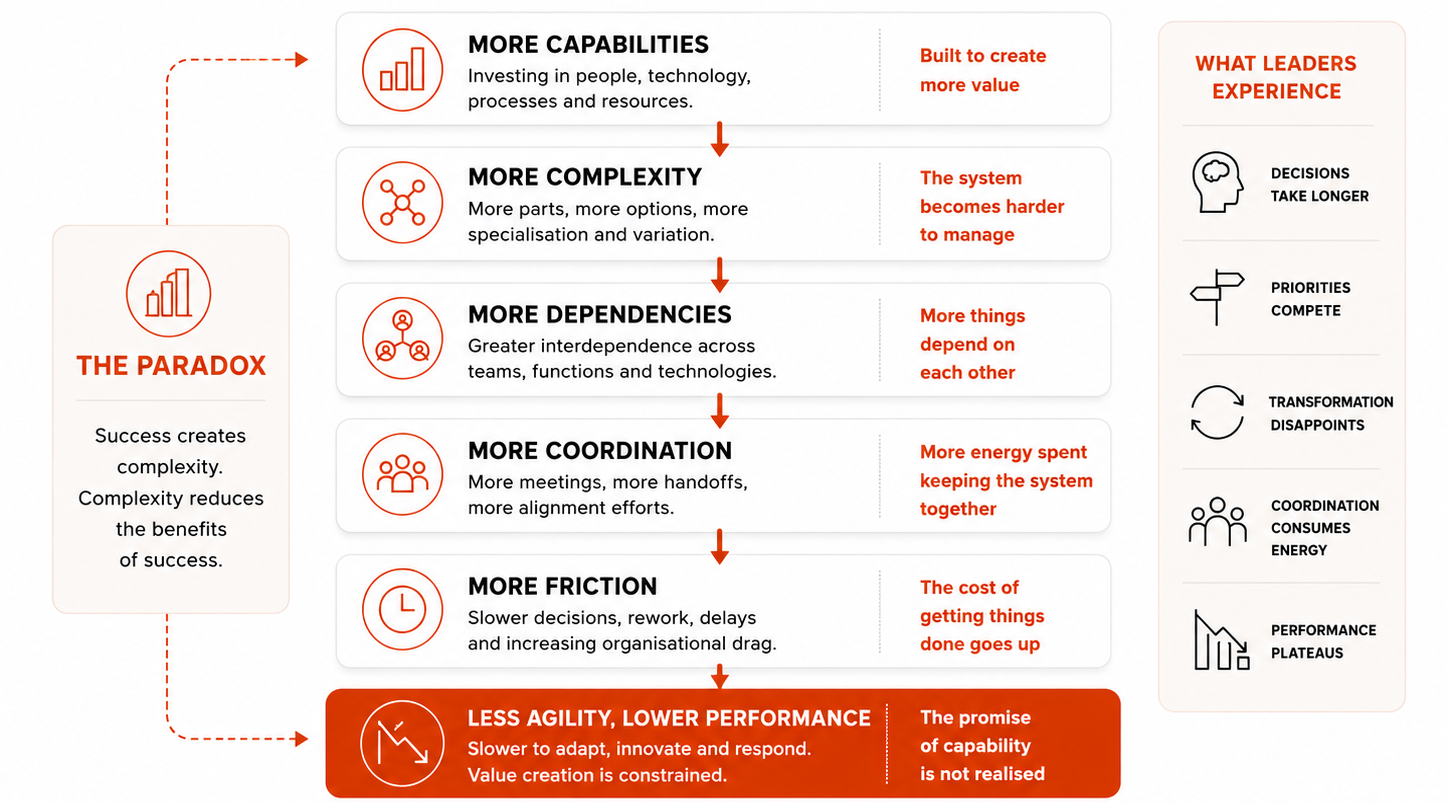
The symptoms are visible across industries and organisational contexts.
Decisions take longer to make, strategic priorities compete for attention, transformation initiatives struggle to achieve their intended outcomes and coordination activities consume an ever-growing share of organisational energy. Leaders find themselves investing significant effort in creating alignment, while employees experience increasing complexity in navigating the structures, processes and dependencies that shape their daily work. What initially appears to be a collection of unrelated challenges gradually reveals itself as a broader organisational pattern.
Most organisations address these challenges individually, treating decision latency, transformation fatigue, governance expansion, fragmentation and coordination overload as separate problems requiring separate interventions. The Coherence Model™ begins from a different premise. It proposes that many of these challenges are not independent phenomena, but rather visible manifestations of a common underlying condition: a widening gap between organisational complexity and organisational coherence.
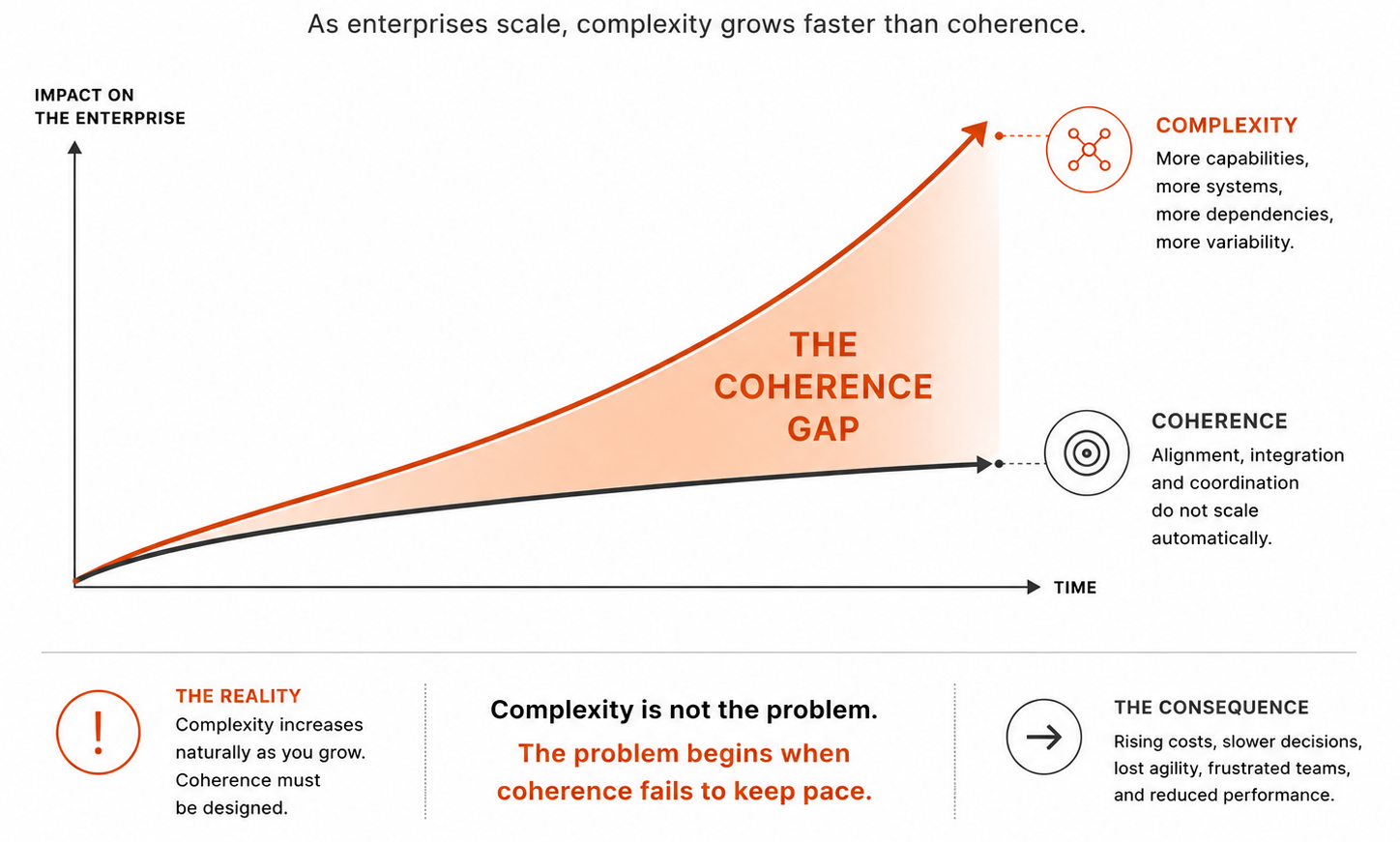
As organisations grow, they naturally introduce new teams, systems, processes, governance structures and specialised capabilities in an effort to improve performance and respond to emerging demands.
Each addition is rational in isolation and often delivers value within its specific domain. At the same time, however, every new capability introduces new dependencies, and every dependency increases the number of interactions that must be coordinated across the enterprise. Over time, the organisation evolves into a highly interconnected system in which decisions, activities and outcomes become increasingly dependent upon one another.
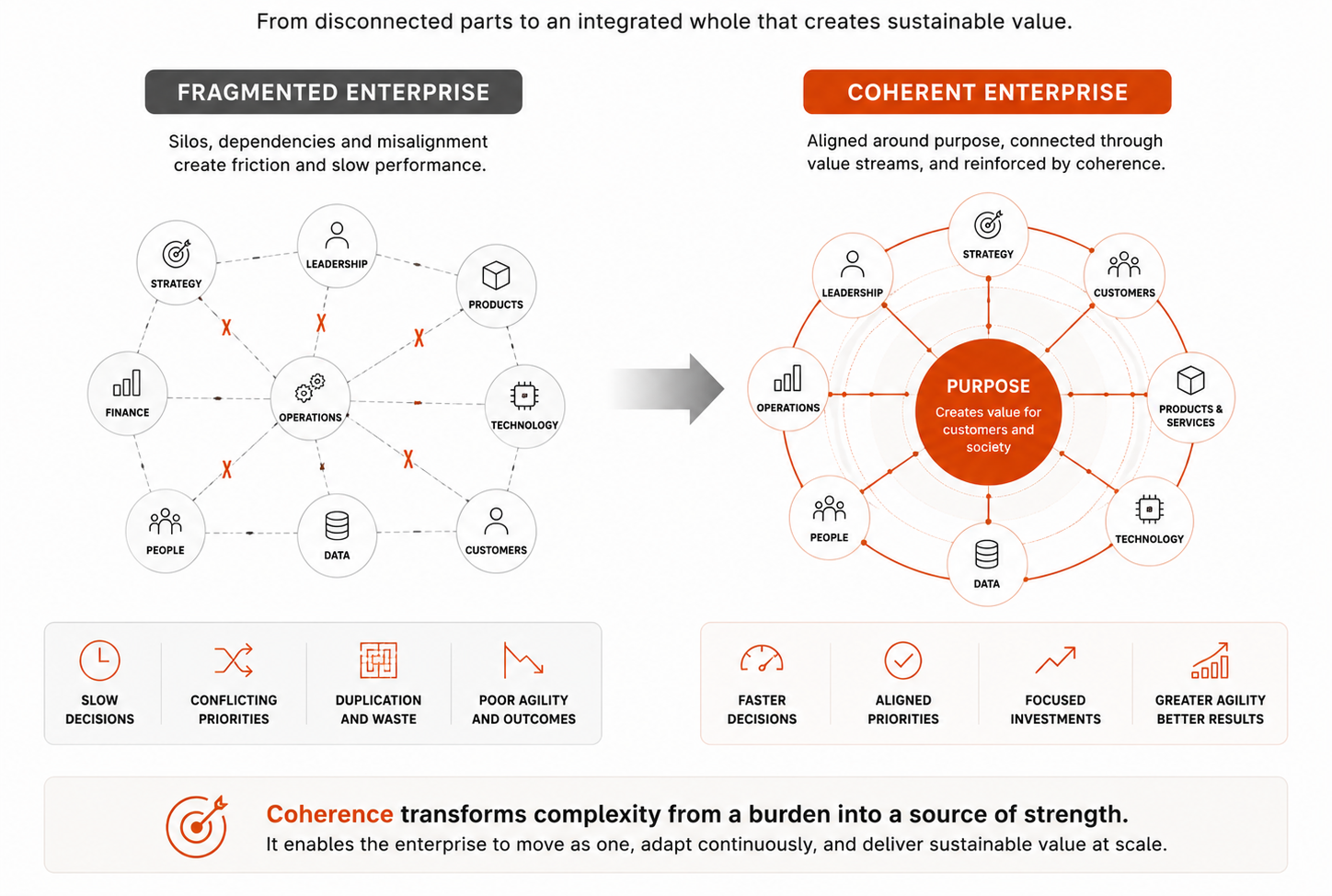
As these interdependencies multiply, coordination becomes more difficult, alignment becomes harder to sustain and fragmentation begins to emerge, not because people lack competence, commitment or expertise, and not because strategy itself is necessarily flawed, but because the enterprise struggles to operate as a coherent whole.
The Coherence Model™ provides a framework for understanding this dynamic and for helping leaders address a set of increasingly important questions. Why does organisational complexity become progressively harder to manage as enterprises grow? Why does coordination consume an ever-larger proportion of organisational capacity?
Why does fragmentation emerge despite significant investments in transformation, technology and organisational improvement? And how can enterprises sustain alignment, adaptability and performance in an environment where complexity continues to increase?
At its core, the model is built on a simple but powerful proposition: enterprise performance depends not only on what an organisation is capable of doing, but also on how effectively its people, teams, functions and systems work together. From this perspective, coherence is not a structure, a governance mechanism or a transformation programme. Rather, it is the organisation's ability to sustain alignment, coordination and effective execution as complexity increases. It is the capacity of the enterprise to move as an integrated system despite the growing number of dependencies that connect its various parts.
Viewed through this lens, many of the challenges confronting modern organisations become easier to understand. Fragmentation is not merely a failure of communication. Coordination overload is not simply a resource problem. Transformation fatigue is not solely the consequence of poor change management. Instead, these conditions often reflect a decline in organisational coherence relative to the complexity the enterprise is attempting to absorb.
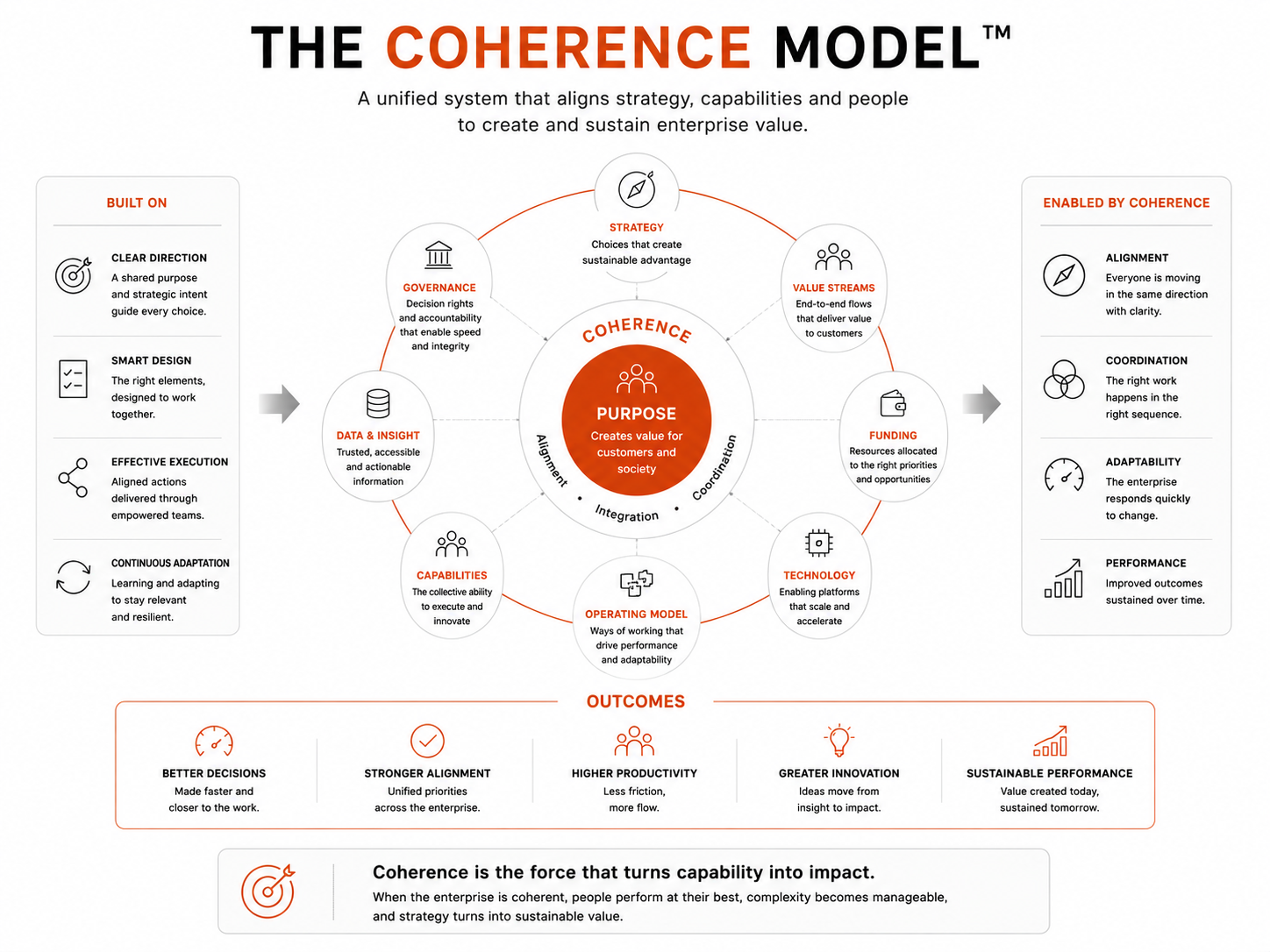
The Coherence Model™ therefore provides leaders with a practical lens for diagnosing fragmentation, identifying sources of organisational friction and strengthening enterprise performance in the complexity era. Rather than focusing exclusively on the addition of new capabilities, structures or initiatives, it encourages leaders to examine how effectively the existing elements of the enterprise reinforce one another, recognising that sustainable performance increasingly depends not on the number of capabilities an organisation possesses, but on the degree to which those capabilities operate as a coherent system.