The Fragmented Enterprise
When Success Creates Separation
Most enterprises do not become fragmented overnight.
Fragmentation rarely emerges through a dramatic failure, a single strategic mistake or an obvious organisational breakdown. In fact, some of the most fragmented organisations in the world continue to appear highly successful from the outside. They report strong financial results, invest heavily in transformation, attract talented people and continuously launch new initiatives designed to improve performance. Their leaders remain ambitious, their strategies appear sound and their organisations are often filled with capable, committed professionals working hard to achieve meaningful outcomes.
Yet beneath this visible activity, something more subtle begins to unfold.
The Growth of Complexity
As organisations grow, they naturally add new capabilities to respond to new demands. New business units are created to serve emerging markets. New technologies are introduced to improve efficiency and enable innovation. New governance structures are established to manage risk and provide oversight. New teams, processes, reporting mechanisms and transformation initiatives are added to address increasingly complex challenges.
Each individual addition is logical. Each solves a real problem. Each creates value within its own domain.
The difficulty is that every new capability also creates new dependencies.
What was once a relatively straightforward organisation gradually evolves into a dense network of interconnected systems, functions and decision structures. Activities that were once contained within a single team now require coordination across multiple departments. Decisions that were once made locally now depend on approval from numerous stakeholders. Information must travel across expanding organisational boundaries, while priorities compete for attention within an increasingly crowded institutional landscape.
The Hidden Cost of Coordination
At first, these changes appear manageable. The organisation compensates through additional meetings, new governance forums, steering committees, reporting structures and coordination mechanisms. These interventions help preserve alignment and maintain control. For a time, they work.
But as complexity continues to accumulate, coordination itself begins consuming a growing share of organisational energy.
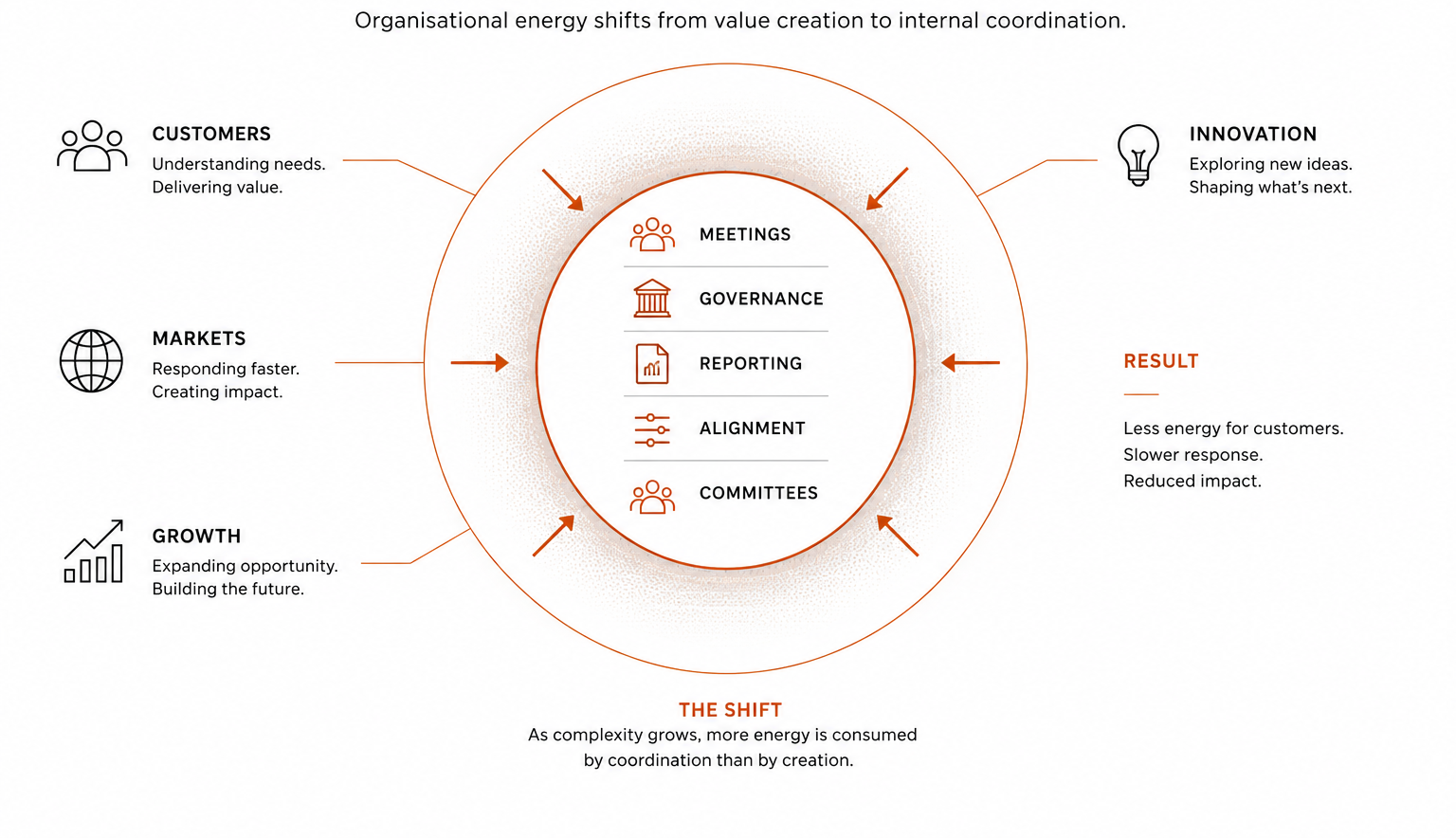
Figure: The Internal Energy Drain
The enterprise becomes increasingly dependent on synchronisation effort simply to maintain movement. Leaders spend more time aligning stakeholders than advancing strategy. Teams devote increasing attention to managing dependencies rather than creating value. Governance expands to address uncertainty, while decision-making slows under the weight of escalating interdependence. Transformation initiatives compete with one another for organisational capacity, and execution becomes progressively harder despite significant investment and effort.
The Emergence of Fragmentation
This is the beginning of fragmentation.
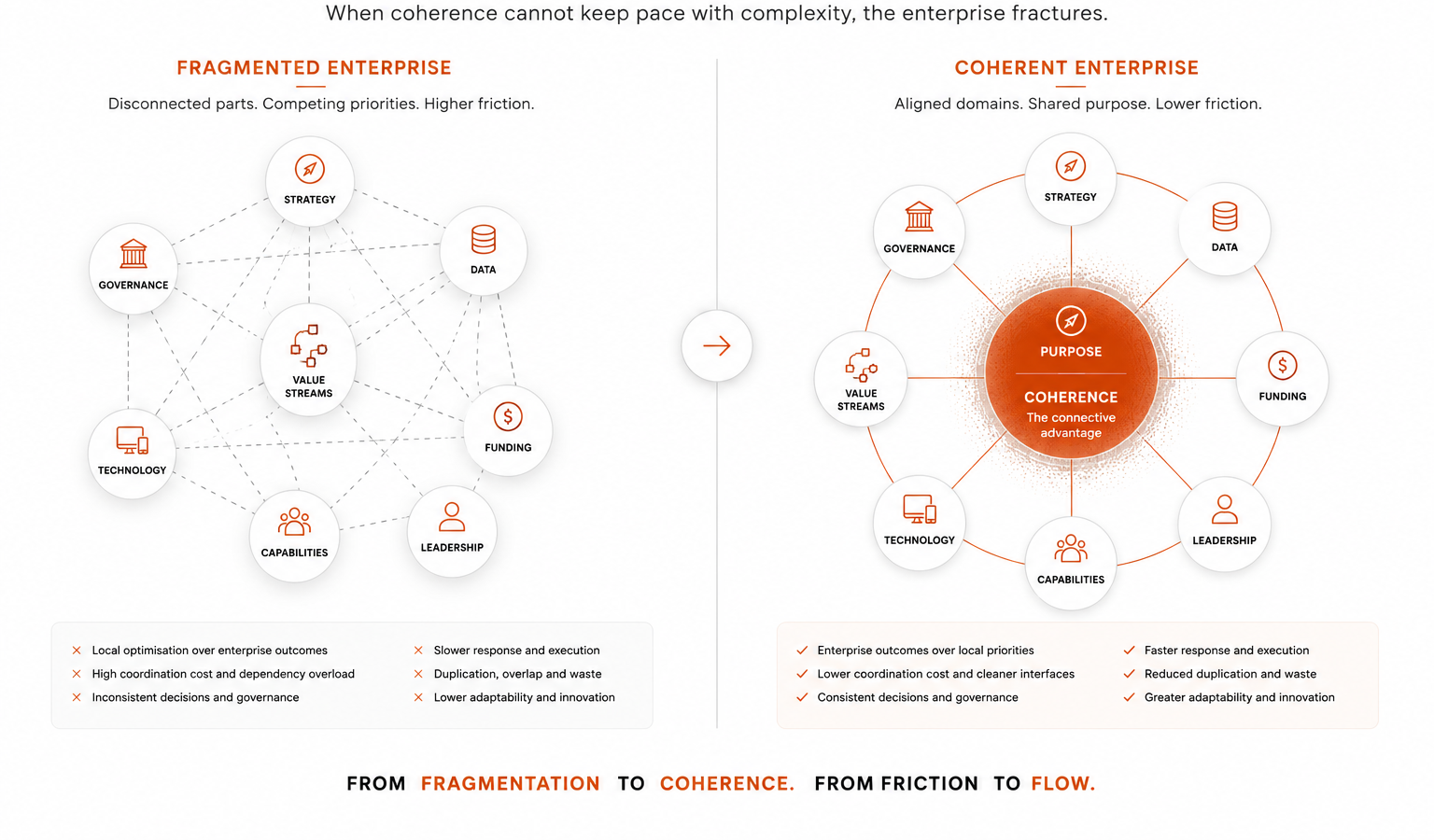
Figure: The Fragmentated Enterprise
Not because people are working against one another. Not because leadership lacks competence. Not because strategy is fundamentally flawed.
Fragmentation emerges because the organisation gradually loses its ability to operate as a coherent whole.
Different parts of the enterprise begin optimising for different objectives. Functions develop their own priorities, metrics and operating rhythms. Business units pursue local performance targets that may not reinforce enterprise-wide outcomes. Technology landscapes evolve according to separate needs and timelines. Governance structures expand independently across organisational domains.
Over time, the connections between these elements weaken, even as the organisation itself becomes more interconnected.
The Hidden Organisation
From the outside, the enterprise may still appear unified.The organisational chart remains intact. Governance forums continue to operate. Leadership teams communicate a common strategy and shared vision. Yet beneath the visible structure, divergence grows. Priorities become misaligned. Decision-making becomes inconsistent. Coordination costs increase. Friction accumulates across organisational interfaces.The enterprise begins behaving less like a single institution and more like a collection of partially connected systems attempting to move in the same direction.This is the hidden organisation that exists beneath the visible organisation.
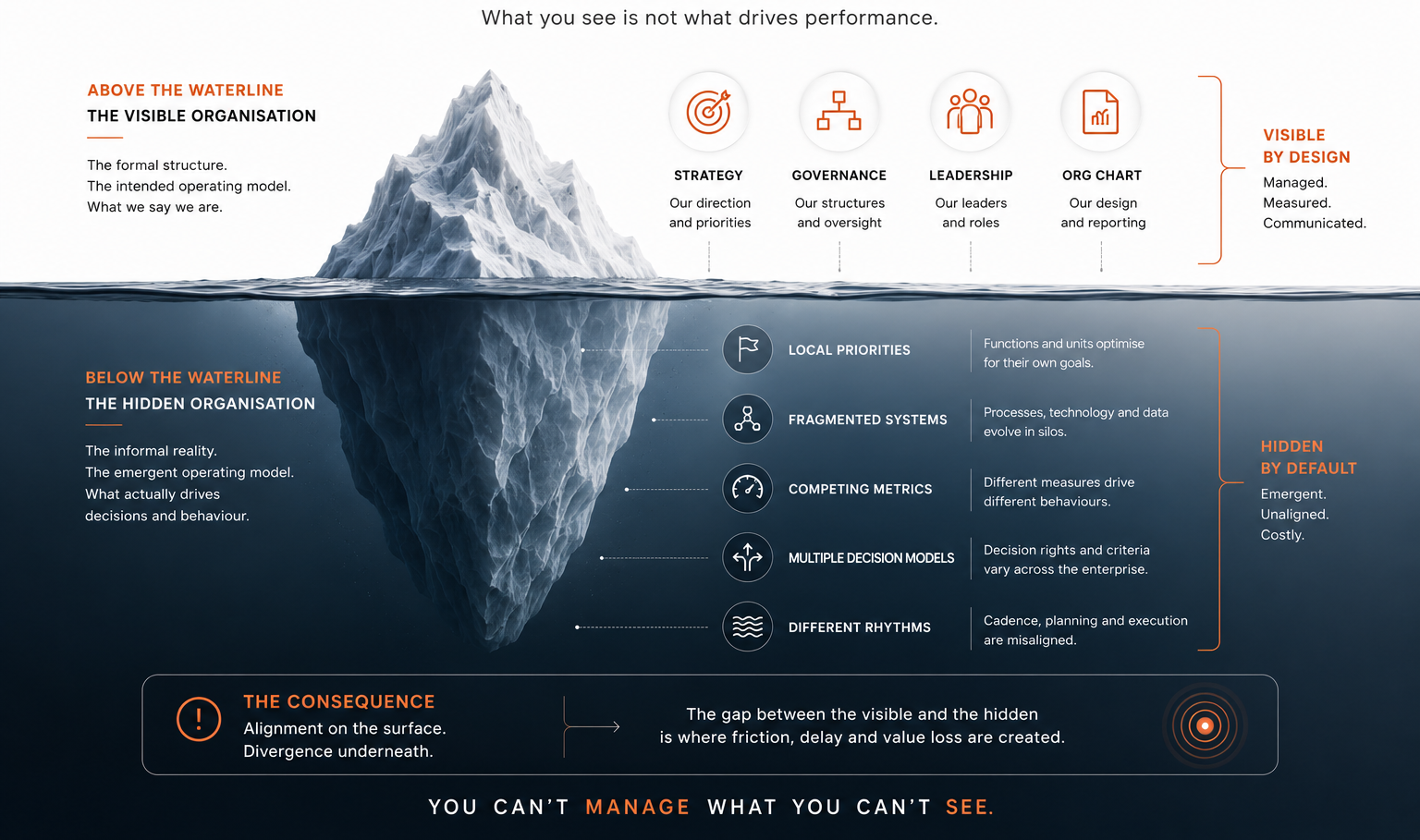
Figure: The Hidden Organisation
When Friction Exceeds Alignment
The consequences extend far beyond operational inefficiency.
Fragmented enterprises become slower to adapt because every meaningful change requires increasing levels of coordination. Innovation becomes more difficult because ideas must navigate disconnected structures and competing priorities. Governance becomes heavier because visibility declines and additional oversight is introduced to compensate. Leadership attention becomes absorbed by escalation management and conflict resolution rather than strategic direction. Employees experience growing complexity, while customers encounter inconsistency across products, services and interactions.
Eventually, the organisation reaches a point where it generates more friction than alignment.
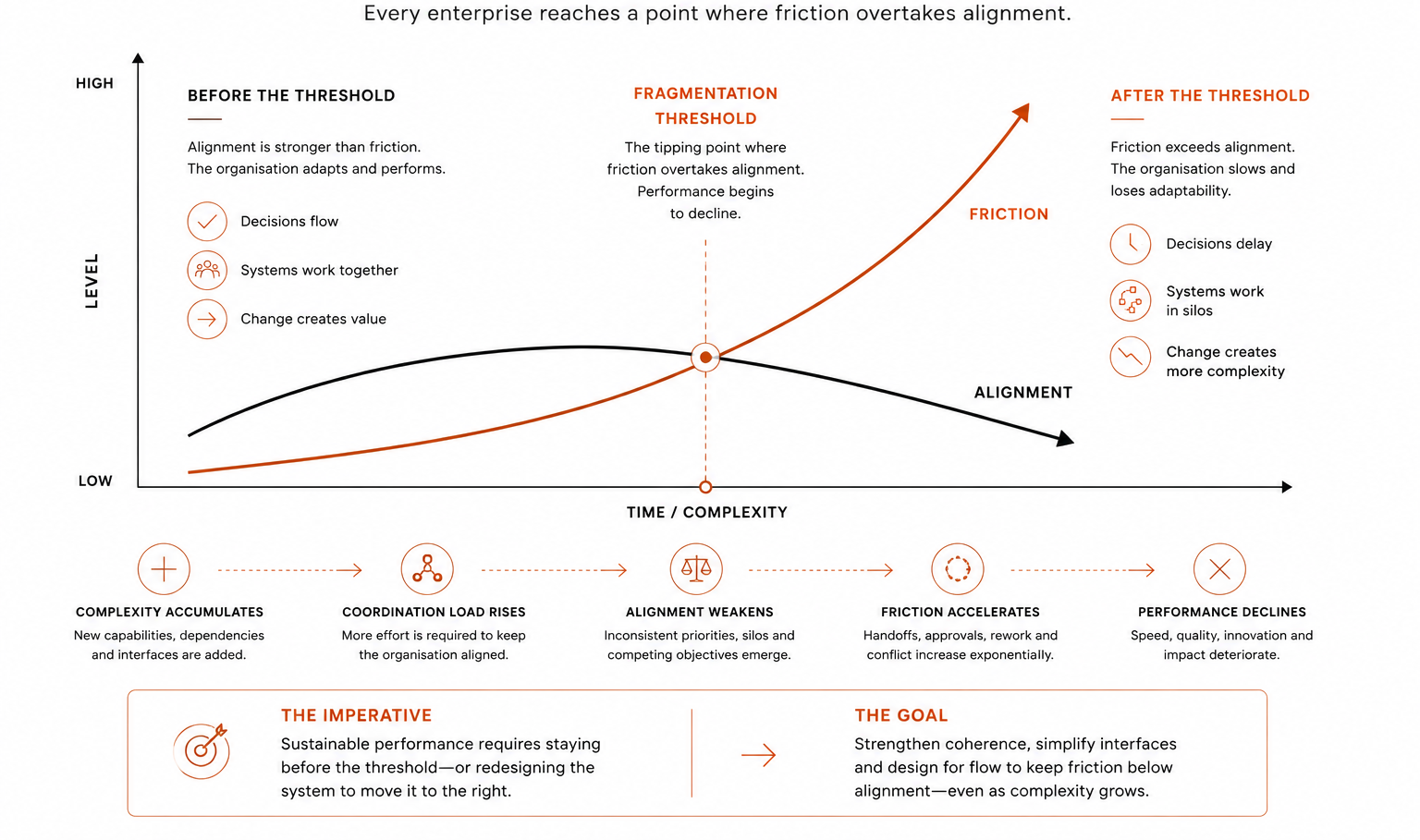
Figure: The Fragmentation Threshold
At this stage, fragmentation is no longer merely an operational inconvenience. It becomes a systemic constraint on performance.
The Cost of Enterprise Fragmentation
The enterprise continues functioning, but it does so through increasing effort, increasing coordination and increasing organisational energy.
Progress requires more meetings.
Decisions require more approvals.
Transformation requires more governance.
Alignment requires more intervention.
The institution remains active, yet its ability to move coherently continues to decline.
The problem is not a lack of activity. The problem is that increasing amounts of activity are required merely to sustain the same level of organisational movement.
The Real Challenge
This is the defining challenge of the fragmented enterprise.The problem is not complexity itself. Complexity is an inevitable consequence of growth, scale and adaptation. The problem arises when coherence fails to keep pace with complexity.
As the gap between the two widens, fragmentation expands, coordination costs increase and enterprise performance becomes progressively constrained.
The organisation becomes more sophisticated, yet simultaneously harder to align, coordinate and adapt.
Towards the Coherent Enterprise
The highest-performing organisations recognise this dynamic.
Rather than continuously adding structures, controls and coordination mechanisms, they focus on strengthening the connections between the systems that already exist. They simplify interfaces, reduce unnecessary dependencies, clarify decision rights and design operating models that reinforce alignment across the enterprise.
They understand that sustainable performance does not depend solely on the capabilities an organisation possesses, but on the degree to which those capabilities work together as an integrated system.
In an increasingly interconnected world, enterprise success may depend less on how much complexity an organisation can absorb and more on its ability to remain coherent while doing so.