The Enterprise Paradox
For generations, organisational progress followed a remarkably simple logic. Whenever new challenges emerged, organisations responded by adding capabilities. New teams were created, new systems implemented, new processes designed, and new layers of expertise introduced. As enterprises grew in scale and ambition, governance structures expanded to provide greater oversight and control. The underlying assumption was clear: more capability would lead to better performance.
For much of the industrial and information age, that assumption proved largely correct. Organisations that developed new competencies, specialised functions, and stronger operational disciplines generally outperformed those that did not. Growth and capability expansion appeared to reinforce one another.
Today, however, many organisations find themselves confronting a very different reality.
Despite unprecedented investments in transformation, digitalisation, innovation, and organisational development, many enterprises struggle to realise the outcomes these initiatives were intended to create. Execution becomes increasingly difficult. Alignment requires greater effort. Strategic priorities compete for attention. Coordination absorbs growing amounts of management capacity. What was once a relatively manageable organisation gradually evolves into a highly interconnected system that becomes increasingly difficult to operate as a coherent whole.
This shift reveals a fundamental paradox at the heart of modern enterprises.
The very actions designed to strengthen an organisation can, over time, make it harder to manage. Every new capability introduces additional dependencies. Every dependency creates new coordination requirements. Every coordination requirement consumes organisational attention and management capacity. While each individual addition may create value in isolation, their cumulative effect can fundamentally alter how the organisation functions.
As complexity accumulates, the enterprise often becomes stronger in its individual parts while simultaneously becoming more difficult to synchronise as a system. Functions optimise locally, but coordination across the whole becomes increasingly challenging. The organisation acquires greater expertise, yet struggles to translate that expertise into collective performance.
This is the Enterprise Paradox.
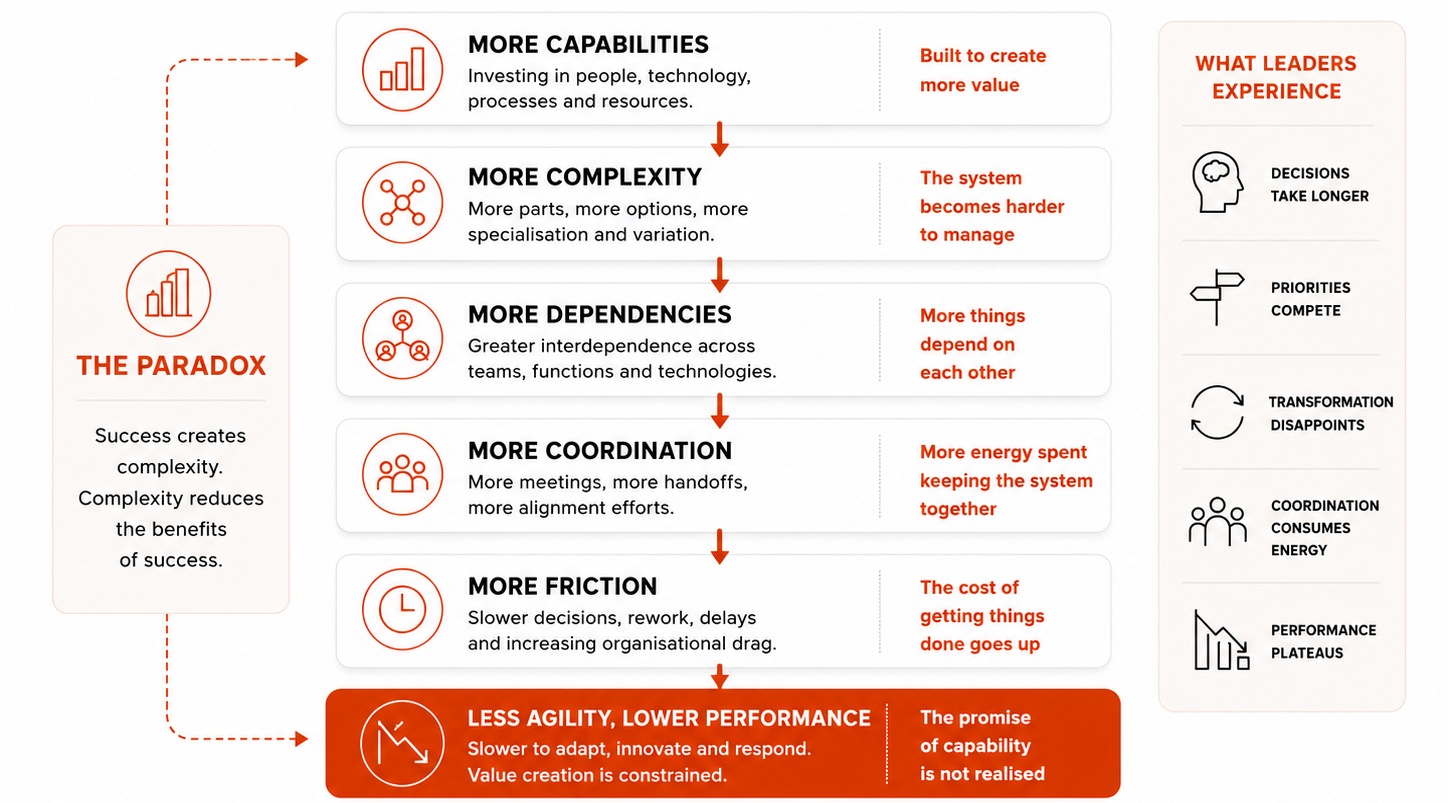
Success generates complexity. Complexity increases interdependence. Interdependence creates coordination demands. And those coordination demands can eventually constrain the very performance they were intended to enhance.
Many organisations respond by introducing additional structures, governance mechanisms, transformation programmes, and oversight processes. Yet such interventions frequently address the visible symptoms rather than the underlying dynamic. More coordination is applied to solve the problems created by excessive coordination. More governance is introduced to manage the complexity generated by existing governance.
The challenge, therefore, is not simply one of managing complexity. Complexity is an inevitable consequence of growth, specialisation, and organisational success. The real challenge is ensuring that complexity does not outpace the organisation's capacity to remain coherent.
Understanding this paradox is becoming increasingly important. The future performance of many enterprises may depend less on their ability to continuously add new capabilities and more on their ability to connect, align, and orchestrate what already exists. In a world of growing interdependence, competitive advantage may no longer be determined by the number of capabilities an organisation possesses, but by how effectively those capabilities work together as an integrated system.