The Coherence Gap
When Something Begins to Change
Most leaders can sense when something is changing inside their organisation.
The symptoms rarely announce themselves dramatically. There is no obvious crisis, no single failure that explains what is happening. In fact, the enterprise may appear successful from the outside. Revenue grows. New initiatives are launched. Transformation programmes remain active. The organisation appears busy, ambitious and fully engaged in moving forward.
Yet beneath the visible surface, a different reality often begins to emerge.
Decisions take longer than they once did. Alignment requires increasing effort. Meetings multiply. Priorities compete for attention. Leaders spend more time coordinating than directing. Teams work harder to achieve outcomes that previously seemed easier to accomplish. The organisation remains active, but movement becomes more difficult.
Beyond Complexity
Many executives describe this condition as complexity. And complexity is certainly part of the story.
Modern enterprises operate in environments shaped by technological acceleration, regulatory expansion, growing interdependence and continuous change. Every year introduces new demands, new capabilities, new systems and new obligations that must somehow be absorbed into the existing organisation.
Yet complexity alone does not explain what leaders are experiencing. Some organisations appear capable of absorbing extraordinary levels of complexity while continuing to move with clarity and purpose. Others struggle despite comparable resources, talent and strategic intent.
The difference often lies elsewhere.
It lies in the organisation's ability to remain coherent.
The Assumption of Modern Management
For decades, management thinking largely assumed that as organisations grew, their coordinating mechanisms would grow with them. New structures would be introduced. New governance would be established. New systems would create visibility. New processes would preserve alignment.
For a time, these interventions work.
But complexity has a tendency to expand faster than the mechanisms designed to manage it.
Every new capability introduces additional dependencies. Every dependency creates new interactions that must be coordinated. Every coordination requirement consumes attention, management capacity and organisational energy.
When Complexity Outpaces Coherence
The result is subtle at first.
The enterprise gradually becomes more interconnected than it is integrated. More sophisticated than it is aligned. More capable than it is coherent.
A gap begins to emerge between the complexity the organisation carries and its ability to move as a unified system.
This is the Coherence Gap.
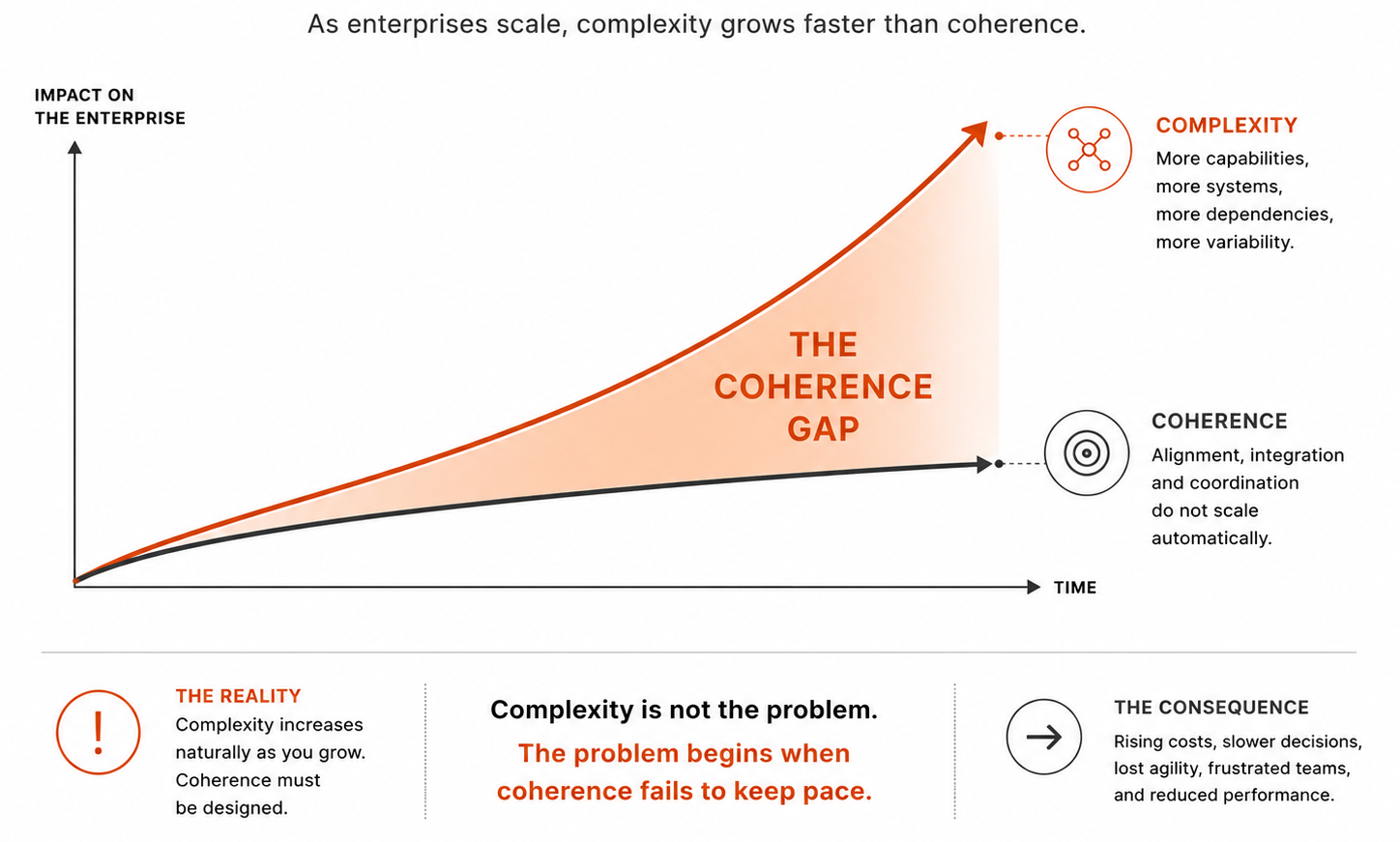
Figure: The Coherence Gap
The Hidden Cost of the Gap
The gap is rarely visible on organisational charts. It does not appear in annual reports. It cannot be measured through headcount, budgets or transformation portfolios alone.Instead, it reveals itself through friction.
Teams wait for decisions. Functions optimise locally while creating difficulties elsewhere. Governance expands but clarity declines. Transformation programmes compete for the same organisational attention. Leaders find themselves continuously reconciling competing priorities that should already be connected through the design of the enterprise itself.
As the gap widens, the organisation begins consuming increasing amounts of energy simply maintaining internal alignment.
More effort is required to achieve the same movement.
More coordination is needed to preserve the same level of performance.
More management attention is absorbed by the organisation itself.
This is why many enterprises can appear simultaneously successful and exhausted.
Why Successful Organisations Still Struggle
The challenge is not a lack of intelligence, commitment or ambition.
In many cases, organisations have never employed more talented people, invested more heavily in technology or pursued more ambitious strategic agendas.
The challenge is that coherence often deteriorates faster than complexity grows.
For years, this deterioration can remain hidden. Strong leaders compensate. Experienced employees navigate around organisational obstacles. Informal networks bridge structural gaps. Success masks the underlying condition.
But eventually the gap becomes too large to ignore.
Decision latency increases.
Transformation fatigue spreads.
Governance becomes heavier.
Adaptability declines.
The enterprise finds itself working harder to achieve less coherent movement.
The Defining Challenge of the Modern Enterprise
At that point, the organisation confronts a reality that many management models still struggle to acknowledge.
The defining challenge of the modern enterprise is not complexity itself. Complexity is now permanent.
The challenge is ensuring that the organisation's capacity for coherence grows as rapidly as the complexity it must absorb.
Because the future will almost certainly bring more technology, more interdependence, more regulation, more transformation and more uncertainty.
The critical question is whether enterprises can remain coherent enough to move effectively within that reality.
The distance between those two forces may ultimately determine which organisations thrive and which gradually become overwhelmed by the weight of their own complexity.
Towards the Coherent Enterprise
The organisations that thrive in the complexity era will not necessarily be those with the most resources, the most technology or the most ambitious transformation agendas.
They will be those that are able to sustain coherence as complexity grows.
Because performance is ultimately determined not only by what an enterprise can do, but by how effectively its people, teams, functions and systems move together as one.