Applying the Model
Applying the Model
From Understanding to Action
The Coherence Model™ is not intended to be a theoretical framework.
Its purpose is to help leaders better understand how their enterprise functions as a system and to identify where fragmentation, friction and coordination challenges are limiting performance.
Applying the model begins with a simple shift in perspective.
Rather than asking how individual functions, departments or initiatives can be improved, leaders begin asking how effectively the enterprise operates as a coherent whole.
This changes the nature of the conversation.
The focus moves away from optimising parts and towards strengthening connections.
Start Where Friction Is Greatest
Most organisations already know where coherence is breaking down.
It is visible in recurring coordination challenges, slow decision-making, competing priorities, transformation fatigue, governance overload and persistent execution difficulties.
These symptoms should not be treated as isolated problems.
They are often signals that coherence is weaker than the complexity the organisation is attempting to manage. The first step is therefore to identify where organisational energy is being consumed by the enterprise itself rather than directed towards customers and value creation.
Diagnose Before You Design
Leaders are often tempted to redesign structures, launch transformation programmes or introduce new governance mechanisms.
The model encourages a different approach.
Before changing the organisation, understand the system.
Where are dependencies increasing?
Where does coordination consume excessive effort?
Where are decisions delayed?
Where do priorities conflict?
Where are value streams interrupted?
Only when these patterns become visible can meaningful improvements be made.
Strengthen the Connections
The objective is rarely to add more capability.
Most organisations already possess significant capability.
The objective is to strengthen the connections between existing capabilities.
This may involve clarifying decision rights, simplifying governance, improving information flows, aligning incentives, strengthening value streams or increasing transparency across organisational boundaries.
The goal is not perfection.
The goal is greater coherence.
Build Coherence as a Capability
Coherence should not be viewed as a one-time initiative.
As complexity continues to grow, coherence must become an ongoing organisational capability.
The most successful enterprises continuously monitor the relationship between complexity and coherence, identifying emerging fragmentation before it becomes a constraint on performance.
They recognise that sustainable success depends not only on what the organisation can do, but on how effectively the enterprise can move as one.
A Practical Example
When Growth Creates Friction
A large financial services organisation had invested heavily in digital transformation.
Over a five-year period, the company introduced new technologies, created specialised product teams, expanded governance structures, increased regulatory controls and launched multiple strategic initiatives designed to accelerate innovation.
From an individual perspective, many of these investments appeared successful.
Technology capabilities improved.
Customer channels expanded.
Data quality increased.
Risk management became more sophisticated.
Yet despite these improvements, executives became increasingly frustrated by the organisation's ability to execute.
Decisions took longer.
Projects required more approvals.
Transformation initiatives competed for resources.
Business units struggled to coordinate priorities.
The enterprise appeared stronger than ever, yet it moved more slowly.
Looking Beyond the Symptoms
The leadership team initially treated each challenge independently.
Governance was reviewed.
Additional steering committees were created.
Reporting mechanisms were expanded.
New coordination meetings were introduced.
Yet performance continued to stagnate.
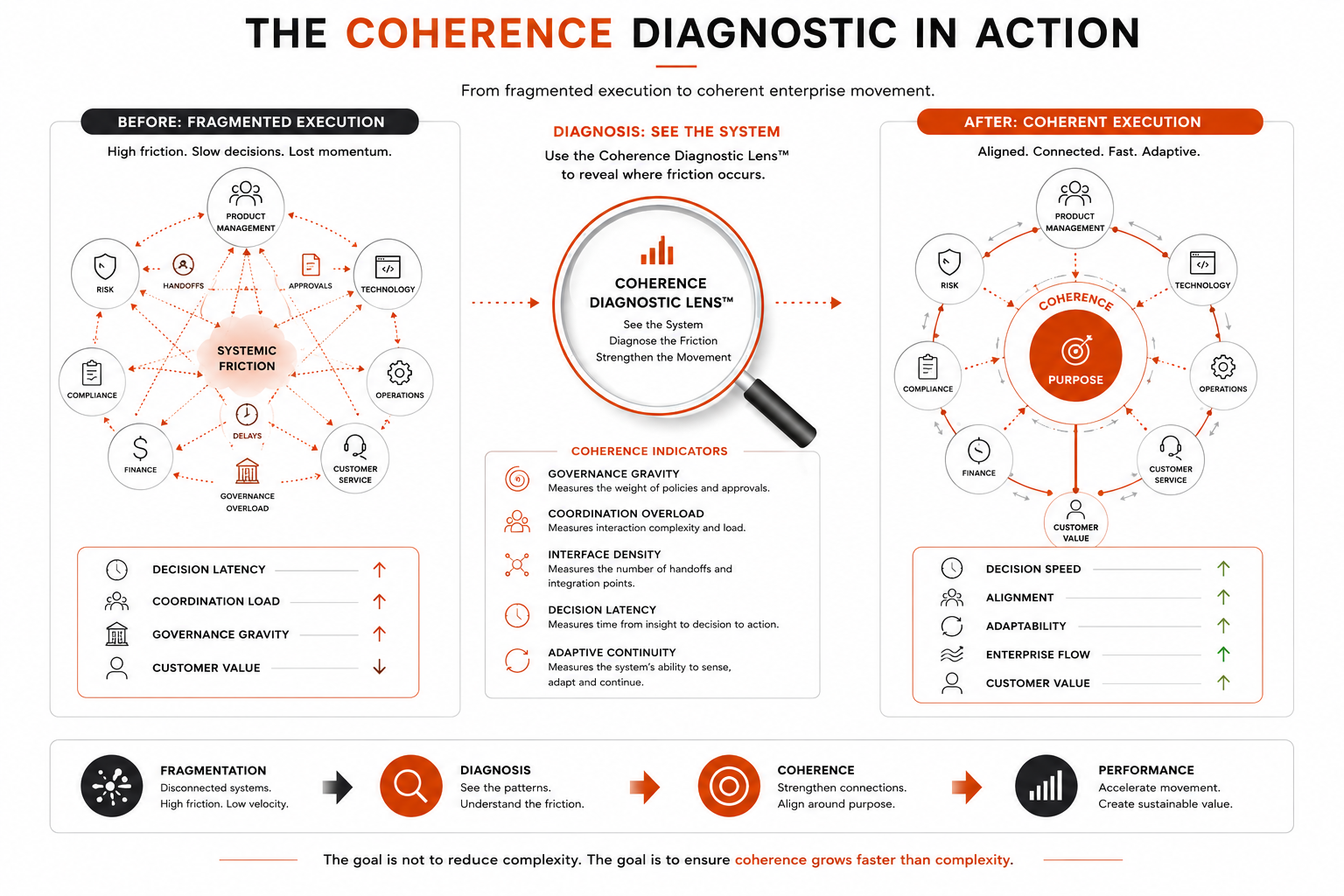
Using the Coherence Diagnostic Lens™, leaders examined the enterprise as a system rather than as a collection of isolated problems.
The assessment revealed several patterns.
Governance Gravity had increased significantly.
Decision Latency had doubled over three years.
Coordination Overload was consuming a growing proportion of management capacity.
Interface Density had expanded as new teams and functions were added.
The issue was not a lack of capability.
The issue was declining coherence.
Diagnosing the Friction
The diagnostic revealed that a single customer-facing initiative required coordination across:
- Product Management
- Technology
- Risk
- Compliance
- Operations
- Finance
- Customer Service
Each function operated effectively within its own domain.
The challenge emerged at the interfaces between them.
Every handoff created delay.
Every approval created waiting time.
Every dependency increased coordination effort.
The enterprise had become highly interconnected but insufficiently integrated.
Strengthening the System
Rather than launching another transformation programme, leadership focused on strengthening coherence.
Decision rights were clarified.
Governance layers were simplified.
Value stream ownership was strengthened.
Information flows became more transparent.
Several approval steps were eliminated.
Cross-functional priorities were aligned around customer outcomes.
The objective was not to add capability.The objective was to reduce friction.
The Result
Within twelve months:
- Decision cycle times decreased by 40%.
- Governance forums were reduced by 30%.
- Cross-functional delivery speed increased significantly.
- Management time spent on coordination declined.
- Customer initiatives reached market faster.
The organisation had not become less complex.
It had become more coherent.
And that distinction proved critical.
Because sustainable performance was achieved not by adding new capabilities, but by improving how existing capabilities worked together as a system.