The Coherent Enterprise™
A Different Way of Thinking
From Control to Coherence
Traditional management responds to complexity with more structure, more control, more oversight. But this often increases friction rather than reducing it.
The Coherent Enterprise™ reframes the question:
How can organisations remain coherent despite growing complexity?
Coherence is not:
- a structure
- a governance model
- a transformation programme
Coherence is the enterprise’s ability to:
- stay aligned
- coordinate effectively
- execute predictably
- move as one system even as complexity grows
The Coherent Enterprise Model™
Designing for Alignment, Flow and Adaptability
Enterprise performance emerges from the interaction of: strategy, governance, funding, capabilities, technology, data, leadership, culture, and value streams .Most organisations optimise individual parts. High‑performing enterprises strengthen the connections between the parts .
The model helps leaders:
- Identify fragmentation
- Reduce organisational friction
- Clarify decision rights
- Strengthen enterprise‑wide alignment
- Prevent bureaucracy from scaling with complexity
The goal is simple: ensure capabilities work together, not against each other
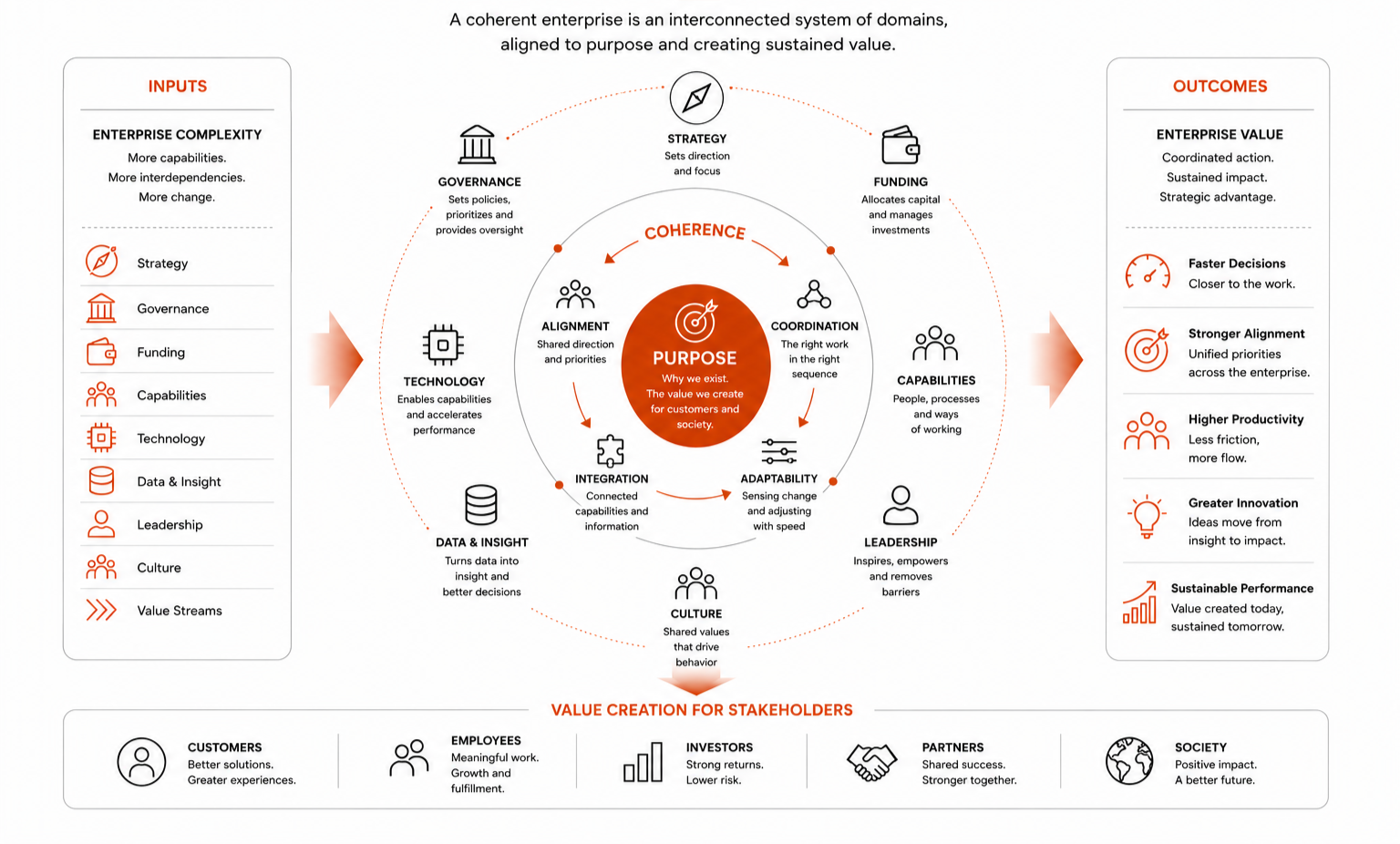
Rather than optimising individual parts of the organisation, the model focuses on strengthening the connections between them.
Because sustainable performance is rarely constrained by the capabilities an organisation possesses.
More often, it is constrained by how effectively those capabilities work together.
The model helps leaders identify fragmentation, reduce organisational friction, clarify decision-making and strengthen enterprise-wide alignment.
Most importantly, it provides a practical way to ensure that growth in complexity does not result in a corresponding growth in bureaucracy.
Why Coherence is the Next Competitive Advantage.
The Organisations That Win Will Be the Ones That Move as One
The future will bring more technology, more interdependence, more regulation, more transformation, and more uncertainty .Every enterprise will add more capabilities. Only some will remain coherent as they grow.
Those that do will:
- Make faster, clearer decisions
- Execute with less friction
- Scale without bureaucracy
- Adapt without losing alignment
- Deliver more value from every transformation initiative
In an interconnected world, advantage depends less on what an organisation can do, and more on how effectively it can move as one .
The Leadership Question That Matters Most
Can Coherence Scale as Fast as Complexity?
Every leadership team must eventually confront a simple question: Can our ability to remain coherent grow as rapidly as the complexity we are creating? The answer will determine whether the enterprise:
- accelerates,
- stagnates,
- or becomes constrained by the weight of its own success.